


Claude Pro vs ChatGPT Plus: both cost $20/month, but they’re built for different jobs. Compare pricing, models, coding tools, and features to pick the right one.
You’ve narrowed your AI subscription search down to two names, and now you’re stuck on the same question a lot of people land on: Claude Pro vs ChatGPT Plus — which one is actually worth your $20 a month?
That price match is exactly what makes this decision tricky. When two products cost the same, you can’t use price as the tiebreaker. You have to look past the number on the pricing page and into what each subscription actually gives you once you’re logged in — the models, the usage caps, the tools bundled in, and the type of work each one was clearly built to handle.
This guide walks through Claude Pro vs ChatGPT Plus from every angle that matters: pricing, usage limits, model quality, coding support, writing performance, extra features, and the kind of user each plan tends to suit best. By the end, you’ll know exactly which one — or whether both — deserves a spot on your monthly bill.
Claude Pro vs ChatGPT Plus at a Glance
| Feature | Claude Pro | ChatGPT Plus |
|---|---|---|
| Price | $20/month, or $17/month billed annually | $20/month, billed monthly only |
| Usage limits | At least 5x the free plan, per 5-hour session, plus a weekly cap | Higher than Free, with its own session and monthly caps |
| Model access | Full model selector across Anthropic’s lineup | Flagship model tier, with a faster default model for routine use |
| Built-in coding tool | Claude Code included in the subscription | Coding agent included, with heavier usage on higher tiers |
| Automation/agents | Cowork for multi-step, semi-autonomous tasks | Agent Mode and Tasks for automation and scheduling |
| Deep research | Standard analysis and file review | A capped number of Deep Research reports per month |
| Voice & media generation | Not a core feature | Advanced Voice Mode and Sora video generation included |
| Office integrations | Google Workspace, Excel, and PowerPoint tools | Not a core feature |
| Custom tools | Projects for organizing ongoing work | Custom GPTs you can build and share |
| Annual discount | Yes | No |
At a glance, the two plans look almost identical: same price, similar structure, both positioned as the “serious user” tier above each company’s free plan. The differences only become obvious once you look at what each one prioritizes.
Pricing: The One Category Where They’re Nearly Tied
Claude Pro and ChatGPT Plus both list at $20 per month, which is unusual in a market where competitors often try to undercut each other. If you’re comparing sticker price alone, it’s essentially a draw.
The one wrinkle: Claude Pro offers a discounted annual billing option, bringing the effective monthly cost down if you commit for a year. ChatGPT Plus, at least for now, is monthly-only, with no standing annual discount.
Featured snippet answer: Claude Pro and ChatGPT Plus both cost $20 per month. Claude Pro offers a lower rate if billed annually; ChatGPT Plus does not currently offer an annual discount.
If you already know you’ll be using one of these tools for the next 12 months regardless, that’s a small but real point in Claude Pro’s favor.
Usage Limits: How Much You Actually Get
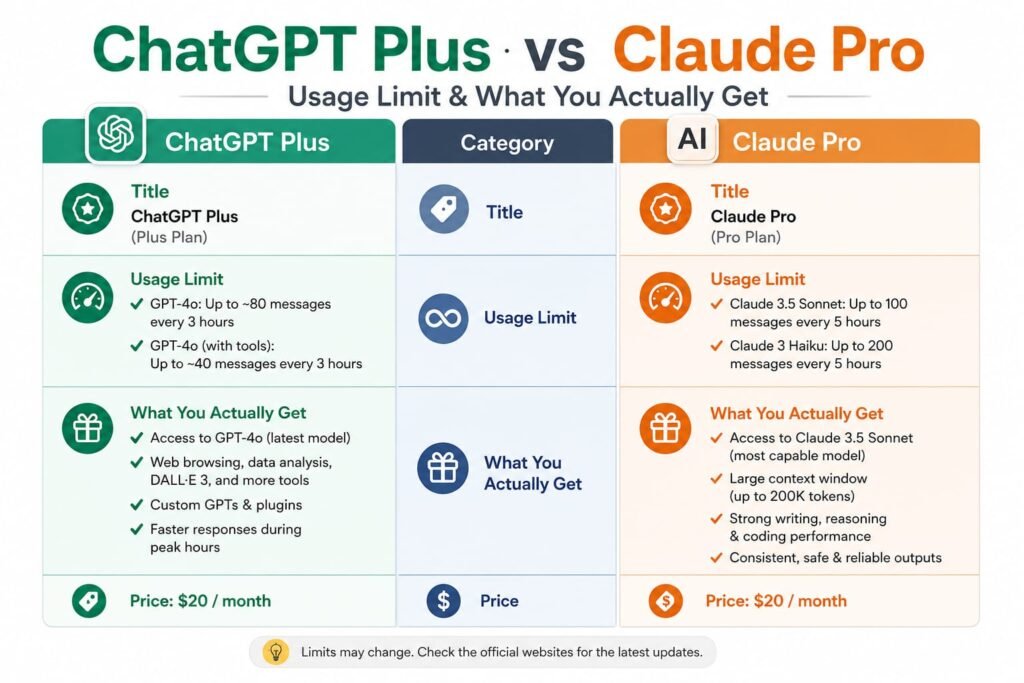
Neither Anthropic nor OpenAI publishes a fixed number of messages per plan, and for good reason — usage is calculated dynamically, based on how long your conversations run, how many files you attach, and which model you’re using at the time. A handful of short exchanges asking for quick facts will burn through your limit far slower than one long conversation analyzing a 40-page report.
That said, here’s the general shape of each plan:
- Claude Pro guarantees at least five times the usage of Claude’s free tier, on a rolling five-hour session window, with an additional weekly cap layered on top. If you blow through that, you can turn on usage credits to keep working at standard rates instead of waiting for the reset.
- ChatGPT Plus similarly scales up from the free tier — more messages, more file uploads, more image generations — plus a set monthly allowance of Deep Research reports, which are more resource-intensive than a normal chat message.
In everyday terms: both plans are designed for consistent daily use by one person, not unlimited, round-the-clock querying. If you’re running an agency, managing a team, or need genuinely heavy daily throughput, both companies push you toward a pricier tier ($100–$200/month) instead.
Model Quality: Where Claude Pro vs ChatGPT Plus Really Diverges
This is the heart of the comparison, and it’s where your actual use case should drive the decision.
Claude Pro gives you access to Anthropic’s full model selector — you can pick a faster model for quick tasks or a more capable one for deep reasoning, long documents, or multi-step analysis. Claude’s reputation has been built largely on long-form writing quality, careful instruction-following, and reasoning that stays coherent across a long back-and-forth. If you’ve ever had an AI tool “forget” an instruction you gave it ten messages ago, that’s the kind of failure Claude is specifically known for avoiding.
ChatGPT Plus gives you OpenAI’s current flagship model for demanding tasks, with a faster model handling routine requests by default. ChatGPT’s strength has traditionally been breadth: it was first to bring voice conversation, image generation, and now video generation directly into the chat interface, and it still leads on raw feature count.
Neither is objectively “smarter” across every task — that’s a moving target that changes with every model release from both companies. But the pattern holds fairly consistently: Claude tends to be the stronger pick for writing, editing, research, and detailed document work; ChatGPT tends to be the stronger pick when you want one tool that also handles voice, images, and video.
Coding Tools: Claude Code vs. ChatGPT’s Coding Agent
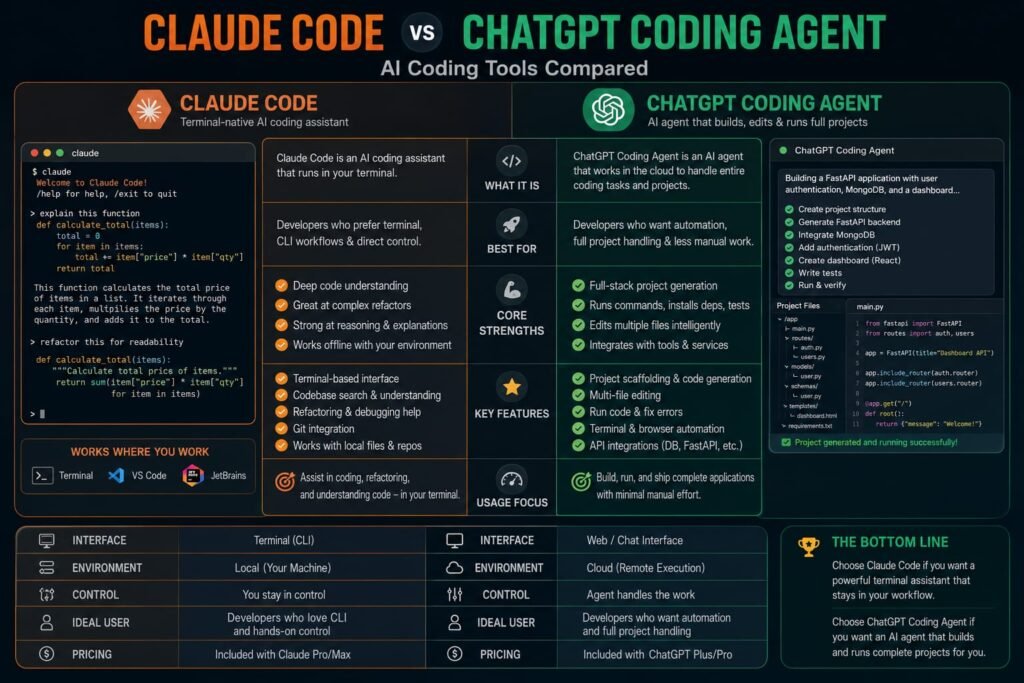
If you write code, this section alone might decide the Claude Pro vs ChatGPT Plus question for you.
Claude Pro bundles Claude Code directly into the subscription — a coding agent that runs in your terminal or inside popular IDEs like VS Code and JetBrains. It can read your entire codebase, understand your project’s structure and conventions, make coordinated edits across multiple files, run your test suite, and keep iterating on a fix until the tests pass. It draws from the same usage pool as your regular Claude chats, so there’s no separate coding subscription to manage.
ChatGPT Plus includes access to OpenAI’s coding agent as well, but the more generous usage allowances for serious, sustained coding sessions are concentrated in the higher-priced Pro tiers rather than the $20 Plus plan.
Example: A developer using Claude Pro for a mid-sized side project — say, refactoring a Node.js API — can run Claude Code directly in the terminal, ask it to trace a bug across three files, and have it apply and test the fix, all within the standard Pro allowance. A ChatGPT Plus user attempting the same sustained, multi-file coding session is more likely to hit a usage ceiling and get nudged toward a paid upgrade.
For developers who want a genuinely capable coding agent included in a $20/month plan — not gated behind a $100+ tier — Claude Pro currently has the edge.
Agentic Features: Cowork vs. Agent Mode
Both companies have moved well past simple chat, building tools that can carry out multi-step work with less babysitting.
Claude Pro includes Cowork, designed for tasks like organizing research files, working across several documents at once, or coordinating a multi-step project without needing a new prompt at every stage.
ChatGPT Plus includes Agent Mode and Tasks, which let ChatGPT take browser-based actions on your behalf and handle scheduled or recurring jobs.
They’re solving the same underlying problem — reducing the amount of manual back-and-forth between you and the AI — but they shine in different settings. Cowork tends to be more useful for document- and research-heavy workflows, while Agent Mode leans toward web-based tasks and ongoing scheduled work.
Extra Features That Might Tip the Scale
A few plan-specific extras are worth knowing about before you commit:
- Voice and media generation: ChatGPT Plus includes Advanced Voice Mode for spoken conversations and Sora for AI video generation — neither is a core part of Claude Pro, which focuses its multimodal capabilities on understanding and analyzing images and documents rather than generating new media.
- Office-suite integration: Claude Pro includes direct Google Workspace integration along with Claude in Excel and Claude in PowerPoint — a real advantage if your daily work lives in spreadsheets and slide decks.
- Custom GPTs: ChatGPT Plus lets you build and share custom GPTs, useful for packaging a repeatable workflow for yourself or a team.
- Deep Research: ChatGPT Plus includes a monthly allowance of in-depth, multi-source research reports as a dedicated feature — something Claude Pro doesn’t package in quite the same form.
Who Should Choose Claude Pro?
Claude Pro tends to be the better fit if you:
- Write, edit, or review long-form content on a regular basis
- Want a genuinely capable coding agent included in your $20 plan, not gated behind a pricier tier
- Work heavily inside Google Workspace, Excel, or PowerPoint
- Value consistent, closely-followed instructions over flashy multimodal extras
- Prefer the option of an annual billing discount
Who Should Choose ChatGPT Plus?
ChatGPT Plus tends to be the better fit if you:
- Want native voice conversations built directly into the app
- Care about AI image and video generation as part of the same subscription
- Like the flexibility of building and sharing custom GPTs
- Want a set monthly allowance of deep, multi-source research reports
- Are already invested in the broader ChatGPT ecosystem
Frequently Asked Questions
Is Claude Pro or ChatGPT Plus better for coding?
Claude Pro tends to be the stronger choice for coding at the $20 tier, since it bundles Claude Code — a full agentic coding tool — into the standard subscription. ChatGPT Plus includes a coding agent too, but its more generous usage limits are reserved for the pricier Pro tiers.
Which is cheaper, Claude Pro or ChatGPT Plus?
Both cost $20 per month at face value. Claude Pro is cheaper on an annual basis, since it offers a discounted rate for yearly billing, while ChatGPT Plus is currently monthly-only.
Can I use Claude Pro and ChatGPT Plus together?
Yes. There’s no restriction on subscribing to both, and plenty of professionals do exactly that — using Claude for writing, research, and coding, and ChatGPT for voice, image, and video tasks.
Does ChatGPT Plus include image and video generation?
Yes. ChatGPT Plus includes Sora for AI video generation and native image generation as part of the standard subscription. Claude Pro does not offer equivalent media-generation tools.
Does Claude Pro include unlimited usage?
No. Claude Pro offers at least five times the usage of the free plan, with both a five-hour session limit and a weekly cap. Unlimited-style, all-day usage is reserved for Anthropic’s higher-priced Max plans.
The Bottom Line
At an identical $20-a-month price, the Claude Pro vs ChatGPT Plus decision isn’t really about cost — it’s about matching the tool to your actual workload. Claude Pro is the more focused option for writing, research, and coding, with genuinely useful office-suite integrations baked in. ChatGPT Plus is the broader, more multimodal option, covering voice, image, video, and custom agents alongside its chat capabilities.
If your work is text-heavy — writing, editing, coding, or analyzing documents — start with Claude Pro. If you want one flexible assistant that also handles voice conversations and generates images and video, ChatGPT Plus is the better starting point. And if your budget allows for $40 a month instead of $20, running both side by side isn’t overkill — it’s simply using each tool for what it does best.
Whichever you choose, both companies update pricing and features often enough that it’s worth a final check on the official Claude and ChatGPT pricing pages before you subscribe.
Pricing and feature details are current as of July 2026 and are subject to change.