
Kimi K3 explained: Moonshot AI’s record-breaking 2.8T-parameter open model. See specs, benchmarks, pricing, and how it compares to rivals.
A new name has been climbing coding leaderboards and stirring up the AI world fast: Kimi K3. Released by Chinese lab Moonshot AI, it’s being described as the largest open-weight model ever announced — and within hours of launch, it reportedly jumped from outside the top 20 straight to the #1 spot on a widely watched front-end coding leaderboard, ahead of models that had been considered nearly untouchable just days earlier.
If you’re trying to figure out what Kimi K3 actually is, whether it’s worth using, and how it stacks up against the likes of Claude, GPT, and Gemini, this guide breaks it all down — the architecture behind it, real benchmark results, exactly what it costs to use, and where it fits if you’re evaluating it for coding, research, or general-purpose work.
What Is Kimi K3?
Featured snippet answer: Kimi K3 is Moonshot AI’s flagship large language model, released on July 16, 2026, built as a 2.8-trillion-parameter mixture-of-experts model with a 1-million-token context window, native visual understanding, and an always-on reasoning mode, positioned as an open-weight alternative to top proprietary models like Claude and GPT.
Moonshot AI, the Beijing-based lab behind the Kimi chatbot, has been building toward this release for a while. The company’s earlier Kimi K2 model, released in mid-2025, had already earned a reputation for strong coding performance at a notably low price. Kimi K3 is the next major leap — bigger, more capable, and pitched directly at the frontier tier occupied by the biggest proprietary labs, while still following Moonshot’s pattern of releasing model weights openly rather than keeping them fully closed.
Inside Kimi K3: Architecture and Technical Specs
Kimi K3’s headline number is its scale: roughly 2.8 trillion total parameters, built on a mixture-of-experts (MoE) architecture. That’s reportedly around 75% larger than DeepSeek’s V4 Pro, one of its closest open-weight rivals, making K3 the largest openly announced model of its kind to date.
A Sparse, Efficient Design
Despite its massive total parameter count, Kimi K3 doesn’t activate all of it at once. Its MoE architecture is highly sparse — only 16 experts out of a pool of 896 are activated for any given token. That sparsity is a deliberate efficiency choice: it keeps inference costs and hardware demands far lower than you’d expect from a model this large.
Kimi Delta Attention and Attention Residuals
Two internally developed techniques underpin K3’s efficiency. Kimi Delta Attention is a hybrid linear attention mechanism that replaces the conventional, ever-expanding key-value cache most transformer models rely on with a fixed-size state handler — reducing both memory use and execution time as context grows. Attention Residuals, the second innovation, functions as a drop-in replacement for standard residual connections, delivering more consistent performance gains as the model scales. Both techniques were previously published as open research by the Moonshot team, so the architecture isn’t a complete black box.
A Massive Context Window
Kimi K3 ships with a 1-million-token context window — large enough to process an entire codebase, a lengthy legal archive, or several full-length novels in a single pass, without needing to chunk the material into smaller pieces.
Always-On Reasoning
Unlike models that let you toggle reasoning on or off, Kimi K3 runs in an always-on “thinking mode.” The reasoning_effort parameter can be set to low, high, or max, but the reasoning process itself can’t be disabled entirely — every output token, including the model’s internal reasoning tokens, is billed at the same output rate.
Native Multimodal and Developer-Friendly API
K3 includes native visual understanding, letting it work directly with images rather than requiring a separate vision-specific model. On the developer side, its API is compatible with the OpenAI SDK, which lowers the barrier for teams already building on OpenAI or Anthropic-style toolchains to test K3 with minimal code changes.
Kimi K3 Benchmarks: How It Actually Performs
Specs are one thing — real-world performance is what actually matters, and this is where Kimi K3 has generated the most attention.
Featured snippet answer: Kimi K3 placed among the top three models across six major coding benchmarks, leading all competitors on SWE Marathon and Program Bench, and trailing GPT-5.6 Sol by only half a point on Terminal Bench 2.1 — while ranking below Claude Fable 5 and GPT-5.6 Sol overall but ahead of both companies’ prior-generation models.
A few specific results stand out:
- K3 reportedly jumped from #18 to #1 on the Frontend Code Arena leaderboard within hours of release, overtaking Anthropic’s Claude Fable 5, which had been considered the front-end coding standard-bearer up to that point.
- On Artificial Analysis’s Intelligence Index, K3 scored competitively enough to be described as landing in frontier territory, with strong marks in coding (98th percentile) and GPQA (99th percentile) categories.
- Cost-per-completed-task figures put K3 at roughly $0.94 per task on certain benchmark measures — cheaper than GPT-5.6 Sol’s $1.04 and Claude Opus 4.8’s $1.80, though more expensive than some lower-cost open rivals like GLM 5.2.
The overall picture: Kimi K3 isn’t the single best model across every category, but it’s genuinely competitive with the top proprietary systems on coding and reasoning tasks specifically, while remaining open-weight — a combination that hadn’t really existed at this scale before.
Kimi K3 Pricing: What It Actually Costs
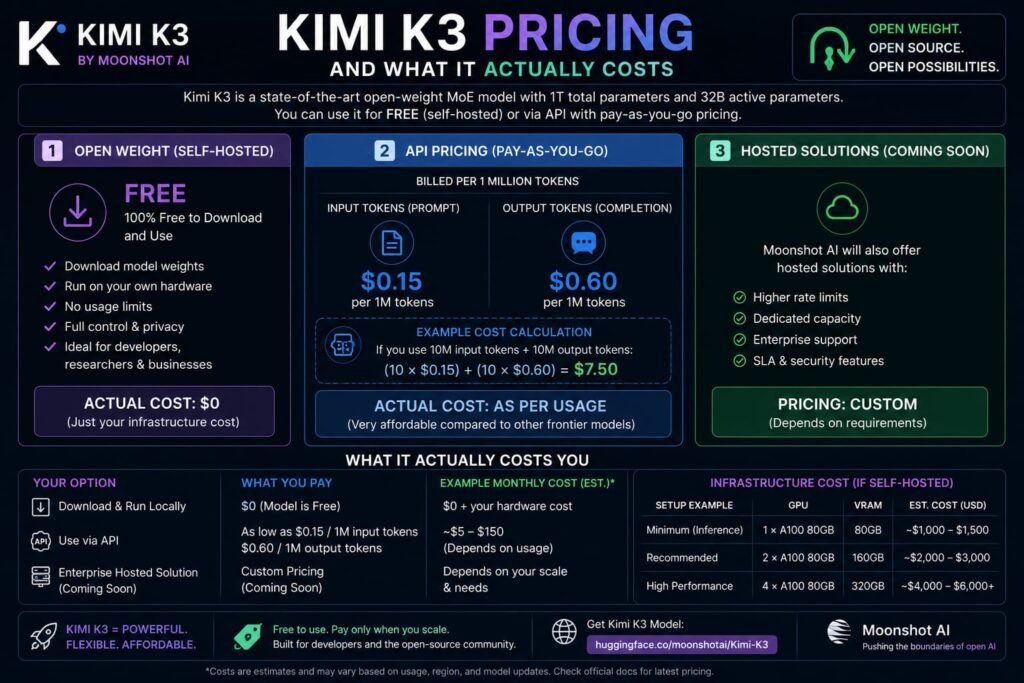
This is where Kimi K3’s positioning gets interesting, because it broke from the pattern many people expected.
Featured snippet answer: Kimi K3 costs $3.00 per million input tokens and $15.00 per million output tokens through Moonshot’s official API, with a cache-hit discount dropping input cost to $0.30 per million tokens — pricing that puts it roughly in line with Claude Sonnet 5 rather than the ultra-cheap tier associated with earlier Chinese open models.
A few details worth knowing if you’re budgeting for real usage:
- Flat pricing across the full context window — unlike some competitors that charge a premium once you cross a certain token threshold, K3’s rate stays the same whether you’re sending 10,000 tokens or 900,000.
- The cache discount matters a lot in practice — a 90% discount on cached input tokens means that for agentic workflows that repeatedly resend the same system prompt or document context, the effective blended cost drops well below the sticker price.
- It’s positioned as a premium option, not a bargain one — K3 costs three to four times more than Moonshot’s own previous flagship, Kimi K2.6, and is notably pricier than other open Chinese models like DeepSeek V4 Pro or GLM 5.2. Compared to the biggest proprietary labs, though, it still undercuts Claude Opus 4.8 and GPT-5.6 Sol on both input and output pricing.
For everyday users who’d rather not think in tokens at all, the Kimi consumer app offers a free tier with unlimited basic chat, file uploads, and web search, plus paid membership tiers running from roughly $19 up to $199 a month for heavier agent and coding use.
Kimi Code: The Coding Agent Built Around K3
Alongside the model itself, Moonshot has been investing heavily in Kimi Code, its open-source coding agent designed to compete directly with tools like Claude Code and Gemini CLI. Kimi Code received two version updates on the same day K3 launched, adding expanded subagent tooling, background task management, and various security fixes.
The tool integrates with popular development environments including VS Code, Cursor, and Zed, and had already accumulated over 3,100 GitHub stars by the time of K3’s release — a signal of genuine developer interest rather than just hype around the model announcement itself.
Inside the Kimi consumer app, two features round out the agentic experience: Swarm, which handles parallel task execution across multiple subtasks at once, and Goal, which lets the assistant work toward an autonomous, multi-step objective rather than requiring a prompt at every stage.
Is Kimi K3 Open-Source? What “Open-Weight” Actually Means Here
Moonshot has billed K3 as intended to be the first open model of this scale — but it’s worth being precise about what “open” means in this context, since the rollout has happened in stages.
The model’s API and web access launched first, available immediately through kimi.com and Moonshot’s developer platform. The actual downloadable model weights were promised as a near-term follow-up, with the company signaling a release window shortly after the initial launch. As with many fast-moving model releases, the exact weights availability has shifted slightly from the original announcement, so if self-hosting is your goal, it’s worth checking Moonshot’s official channels or Hugging Face directly for the current status before planning around it.
Once weights are available, K3’s open-weight status matters most for organizations with existing GPU infrastructure, strict data residency requirements, or high enough usage volume that self-hosting becomes cheaper than paying per token — for most casual or small-scale users, the hosted API or consumer app will remain the simpler path regardless of whether weights are downloadable.
Should You Use Kimi K3?
Whether Kimi K3 makes sense for you comes down to what you’re optimizing for:
Choose Kimi K3 if you want frontier-level coding and reasoning performance with the option of self-hosting down the line, you’re already comfortable with OpenAI-SDK-compatible tooling, or your workload benefits from a genuinely massive 1-million-token context window without a long-context pricing penalty.
Consider a cheaper alternative if your budget is the top priority — models like DeepSeek V4 Pro or GLM 5.2 cost meaningfully less per token, even if they trail K3 on some benchmarks.
Stick with an established proprietary model if you need the absolute top-ranked performance regardless of cost or openness — Claude Fable 5 and GPT-5.6 Sol still edge out K3 in overall rankings, even though K3 has closed the gap significantly and beats both companies’ prior-generation models outright.
Frequently Asked Questions
What is Kimi K3 used for? Kimi K3 is built for complex coding, long-horizon agentic workflows, and knowledge work that benefits from a large context window — tasks like navigating large codebases, debugging, iterating on tests and logs, and multi-step research and drafting.
How much does Kimi K3 cost to use? Through Moonshot’s API, K3 costs $3.00 per million input tokens and $15.00 per million output tokens, with cached input dropping to $0.30 per million. The consumer Kimi app offers a free tier plus paid plans from about $19 to $199 a month.
Is Kimi K3 better than Claude or GPT? Not quite, on overall rankings — Kimi K3 currently sits just below Claude Fable 5 and GPT-5.6 Sol in most benchmark comparisons, though it beats both companies’ prior-generation models and leads specific benchmarks like SWE Marathon and Program Bench outright.
Is Kimi K3 free and open-source? The web app and API launched first, with downloadable model weights promised as a near-term follow-up rather than available at initial launch. Check Moonshot’s official channels for the current weights release status before planning around self-hosting.
How big is Kimi K3 compared to other models? At roughly 2.8 trillion total parameters, Kimi K3 has been described as the largest open-weight model announced to date — about 75% larger than DeepSeek’s V4 Pro, one of its closest open-weight competitors.
My Final Thoughts for Kimi’s new Model Kimi K3
Kimi K3 is a genuinely significant release — not because it’s the single best model on the market, but because it puts frontier-level coding and reasoning performance within reach of an open-weight model for the first time at this scale. It isn’t the budget option some expected from a Chinese lab, but its pricing still undercuts the biggest proprietary flagships while getting remarkably close to their performance.
If you’re deciding whether to build with it, the smartest first step is a hands-on test rather than benchmark-reading alone: try Kimi K3 through the free web app at kimi.com, or run a small workload through the API to see how the cache discount and 1-million-token context actually perform on your own tasks. That real-world trial will tell you more than any leaderboard score about whether K3 belongs in your toolkit.
Related Reads:
What Is Lovable AI? The Complete Guide to the AI App Builder Everyone’s Talking About
Is Lovable AI Free? Here’s What You Actually Get
Claude Pro vs ChatGPT Plus: The Real Difference Between These $20 AI Plans
How to Fix AI Image Generator Deformities in Fingers, Toes, and Other Anomalies
What Is Meta AI Muse Spark? The Complete 2026 Guide to Meta’s Flagship AI Model