

Seedance 2.5 is ByteDance’s 30-second AI video model with 50 references and native editing. Learn features, pricing, release date, and how it compares.
If you have ever tried to make a 30-second AI video, you already know the pain. You generate a 6-second clip that looks perfect, then generate the next one, and suddenly the lighting shifted, the character’s face changed, and the camera move no longer matches. By the time you stitch four clips together, you have spent more time fixing seams than you would have spent shooting the scene yourself.
That is exactly the problem seedance 2.5 was built to solve. Announced by ByteDance at the Volcano Engine FORCE Conference on June 23, 2026, Seedance 2.5 is the first major AI video model to generate a native 30-second clip in a single pass—no stitching, no seams, no consistency breaks. It also accepts up to 50 multimodal references, edits finished footage without regenerating the whole clip, and outputs native 4K with synchronized audio.
But here is what the announcement videos do not tell you: the model has no free tier, the public release is rolling out in stages, and the Hollywood copyright dispute that froze Seedance 2.0 is still unresolved. This guide gives you the full picture—what Seedance 2.5 actually does, how much it costs, where you can access it, and whether it lives up to the hype.
What Is Seedance 2.5?
Seedance 2.5 is ByteDance’s next-generation AI video generation model, developed by the same research division behind TikTok’s recommendation algorithms. It belongs to ByteDance’s broader “Seed” model family, which also includes Seed-TTS for text-to-speech, Seed-ASR for speech recognition, and Seedream for image generation.
The model was unveiled on stage by Volcano Engine president Tan Dai on June 23, 2026, with enterprise beta access opening immediately and public availability targeted for early July 2026. The trial center and API opened fully on August 7, 2026.
What makes Seedance 2.5 different from a typical model upgrade is that it does not just improve visual quality—it restructures the entire production workflow. Instead of generating fragments and stitching them, you generate complete scenes. Instead of hoping the model remembers your character, you feed it 50 reference assets. Instead of regenerating a whole clip to fix one detail, you edit just that detail.
The 30-Second Breakthrough: Why Native Length Changes Everything
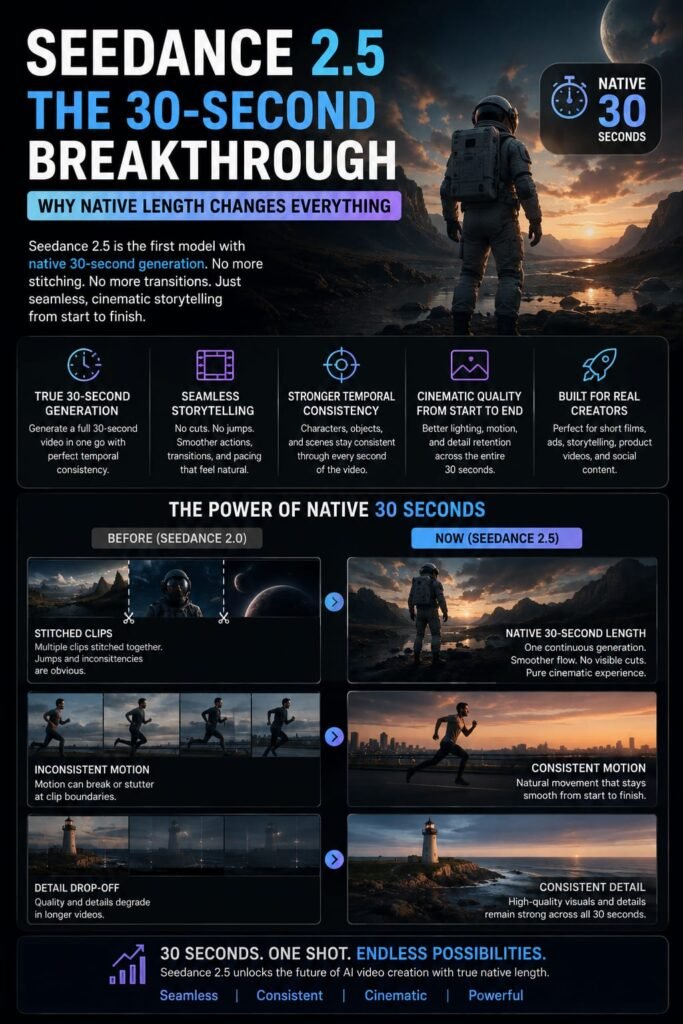
The headline feature of seedance 2.5 is 30-second native generation. That might sound like a modest improvement over the 15-second ceiling of Seedance 2.0 or Kling 3.0, but for production teams, it is a workflow revolution.
The Stitching Problem
Most leading AI video models—Google Veo 3.1, Runway Gen-4, Kling 3.0—cap single-pass generation at 8 to 15 seconds. For anything longer, you stitch multiple generations together. The problem is that each generation is stateless. The model does not remember what it created in the previous clip. By the time you are on your fourth or fifth generation, character appearance has drifted, lighting has changed tone, and motion style has shifted.
For a 30-second ad spot, that means two to four generation passes plus manual correction at every join. The time overhead is real, and the consistency overhead is worse.
How 30 Seconds Solves It
Seedance 2.5 generates the full 30-second clip in one forward pass. The model’s attention mechanisms and temporal modeling work across the entire duration, so characters, lighting, and motion physics hold together without patchwork fixes.
Thirty seconds is also a meaningful unit for actual content. It covers a complete social ad, a product walkthrough, a short brand spot, or a narrative scene with a beginning, middle, and end. You are not generating fragments—you are generating finished pieces.
| Model | Max Native Clip Length |
|---|---|
| Google Veo 3.1 | 8 seconds |
| Runway Gen-4 | 12 seconds |
| Kling 3.0 | 15 seconds |
| Seedance 2.0 | 15 seconds |
| Seedance 2.5 | 30 seconds |
How long can Seedance 2.5 videos be? Seedance 2.5 generates up to 30 seconds of video in a single native pass, double the 15-second ceiling of Kling 3.0 and Seedance 2.0.
50 Multimodal References: Directing the Model Instead of Prompting It
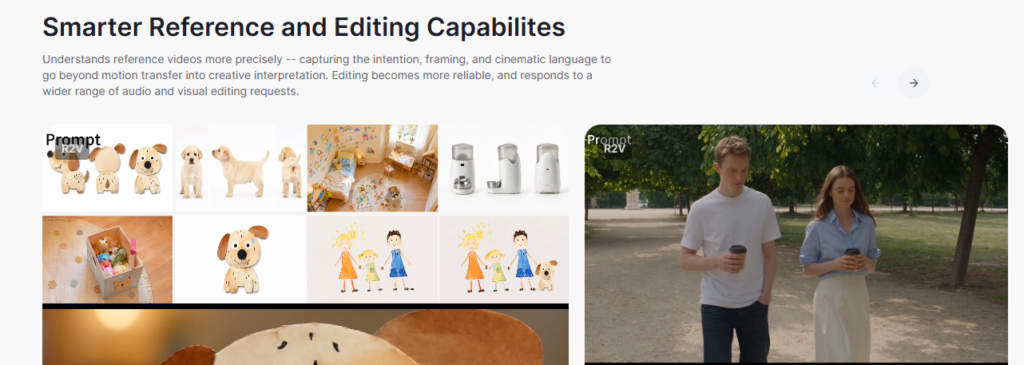
The second major upgrade in seedance 2.5 is reference capacity. The model accepts up to 50 simultaneous multimodal reference inputs—up from 12 in Seedance 2.0.
This is not just “more images.” The reference set can include:
- 30 images: Character sheets, product shots, style references, environment photos
- 10 video clips: Motion references, camera movement examples, pacing guides (2–30 seconds each)
- 10 audio clips: Music tracks, sound design, voice samples to drive pacing and lip sync
For the first time, audio-only reference is supported. A single music track can drive the pacing, hit points, and lip synchronization of the generated video.
Why 50 Matters
At 12 references, you can supply a character sheet and a handful of style examples before the budget fills. At 50, a brand team can simultaneously feed the model a full product shoot, multiple character angles, brand motion guidelines, environmental references, audio tone samples, and even a 3D model of the product. The model holds all of those constraints at once.
| Model | Max Reference Inputs |
|---|---|
| Google Veo 3.1 | ~3 |
| Runway Gen-4 | ~4 |
| Kling 3.0 | ~5 |
| Seedance 2.0 | 12 |
| Seedance 2.5 | 50 |
Semantic Local Editing: Fix One Detail, Keep Everything Else
Perhaps the most practical upgrade in seedance 2.5 is the ability to edit inside a finished video. Instead of regenerating the entire clip because one element is wrong, you can:
- Swap a product variant
- Replace an actor’s clothing
- Remove a rig or unwanted object
- Relight the entire scene
- Change a background locale
- Extend a clip forward or backward
The rest of the frame—the camera move, the pacing, the motion, the characters you did not touch—stays exactly where it was.
For high-SKU e-commerce brands, this means one master product shot becomes dozens of variants without a full re-generation. For localization teams, it means swapping backgrounds for different markets while keeping the talent and motion identical. For filmmakers, it means fixing a detail in post without losing the take.
Native 4K, Audio, and 10+ Languages
Seedance 2.5 outputs at native 4K resolution. This is not an upscaled 1080p—4K is generated natively, which matters for large displays, pitch decks, and anywhere 1080p looks soft.
The model also features unified joint audio-video generation. Visual and audio signals are co-processed in the same latent space rather than generated separately and synchronized after the fact. This produces more coherent sound design, music pacing, and lip sync.
Language support includes Chinese, English, Spanish, Indonesian, Malay, Thai, Arabic, Portuguese, Vietnamese, Japanese, and Korean, with lip sync following the named language automatically.
3D White-Box Preview: Test Before You Render
Seedance 2.5 includes a 3D white-box preview feature. You can feed an untextured 3D blockout plus material and style references, and the model returns a low-fidelity animation for testing composition, spacing, and motion before committing to a full render.
For film, advertising, and game teams, this replaces expensive pre-visualization workflows. You lock spatial relationships and camera moves in minutes instead of days.
Seedance 2.5 Pricing and Cost Structure
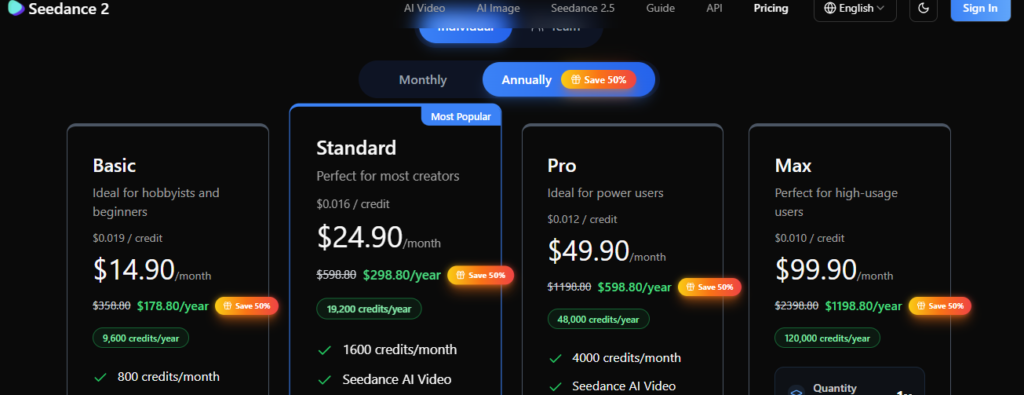
Pricing for seedance 2.5 follows the same usage-based structure as Seedance 2.0, with costs driven by three factors: generated seconds, resolution, and reference inputs.
Per-Second Pricing (Seedance 2.0 Pro Rates)
Based on Seedance 2.0 Pro pricing, expect similar rates for 2.5:
| Resolution | Cost Per Second |
|---|---|
| 480p | ~$0.10 |
| 720p | ~$0.20 |
| 1080p | ~$0.50 |
A 30-second clip at 1080p would cost approximately $15. At 4K, the rate is higher—exact 4K pricing for 2.5 has not been officially published, but expect a significant premium over 1080p.
Reference Input Costs
Video references used as inputs may incur additional charges, typically at 50% of the output rate per second of input video. A 10-second reference clip at 1080p would add roughly $2.50 to the total cost.
Platform Pricing
On third-party platforms, credit-based pricing varies. On Tryonr, a Seedance 2.5 generation requires 720 credits for a standard text-only 4-second clip at 1080p. On Higgsfield, Seedance 2.0 clips cost approximately $3.00 each, compared to $3.60 on Runway for the same model.
Important: Seedance 2.5 has no free quota at all on ByteDance’s official platform. Access requires an account balance over ¥200 (approximately $28) or an existing Seedance 2.0 resource pack with remaining quota.
Featured snippet answer: How much does Seedance 2.5 cost? Seedance 2.5 uses usage-based pricing starting at approximately $0.10 per second for 480p and $0.50 per second for 1080p. A 30-second 1080p clip costs roughly $15. There is no free tier—access requires a minimum balance of approximately $28 on ByteDance’s platform.
Where to Access Seedance 2.5
As of August 2026, Seedance 2.5 is available through multiple channels:
ByteDance Official Platforms:
- Volcano Engine API: Direct API access for enterprise and developers
- Dreamina: ByteDance’s creative platform (CapCut ecosystem)
- Jimeng: ByteDance’s domestic Chinese platform
Third-Party Platforms:
- Tryonr: Browser-based generation with credit packs
- Morphic: Canvas-based AI video platform
- Flova AI: Expected to add support with promotional credit bonuses
- Higgsfield: Multi-model platform hosting Seedance alongside Kling and Veo
- JXP: Platform with free trial credits for new users
Access is rolling out in stages. ByteDance’s own apps typically get new versions first, followed by third-party platforms once the API opens.
Seedance 2.5 vs Competitors
| Feature | Seedance 2.5 | Kling 3.0 | Veo 3.1 | Runway Gen-4 |
|---|---|---|---|---|
| Native clip length | 30s | 15s | 8s | 12s |
| Max references | 50 | ~5 | ~3 | ~4 |
| Native 4K | Yes | 1080p | 1080p | Up to 1080p |
| Local editing | Yes | Limited | No | Limited |
| 3D preview | Yes | No | No | No |
| Native audio | Yes | Yes | Yes | Limited |
| Cost per minute (1080p) | ~$9–$15 | ~$20 | ~$24 | ~$22 |
| Exclusive models | No | No | No | Gen-4.5 |
Seedance 2.5 leads on clip length, reference capacity, and cost efficiency. However, Runway’s Gen-4.5 is widely considered the strongest single cinematic model for pure visual quality and is exclusive to Runway. If Gen-4.5 is your primary model, Runway remains the only option regardless of Seedance’s specs.
Featured snippet answer: Is Seedance 2.5 better than Kling 3.0 and Veo 3.1? Seedance 2.5 generates longer clips (30s vs 15s/8s), accepts more references (50 vs 5/3), and costs less per minute of 1080p output. However, Kling 3.0 and Veo 3.1 may still win on specific visual styles or motion quality depending on the project.
Real-World Use Cases for Seedance 2.5
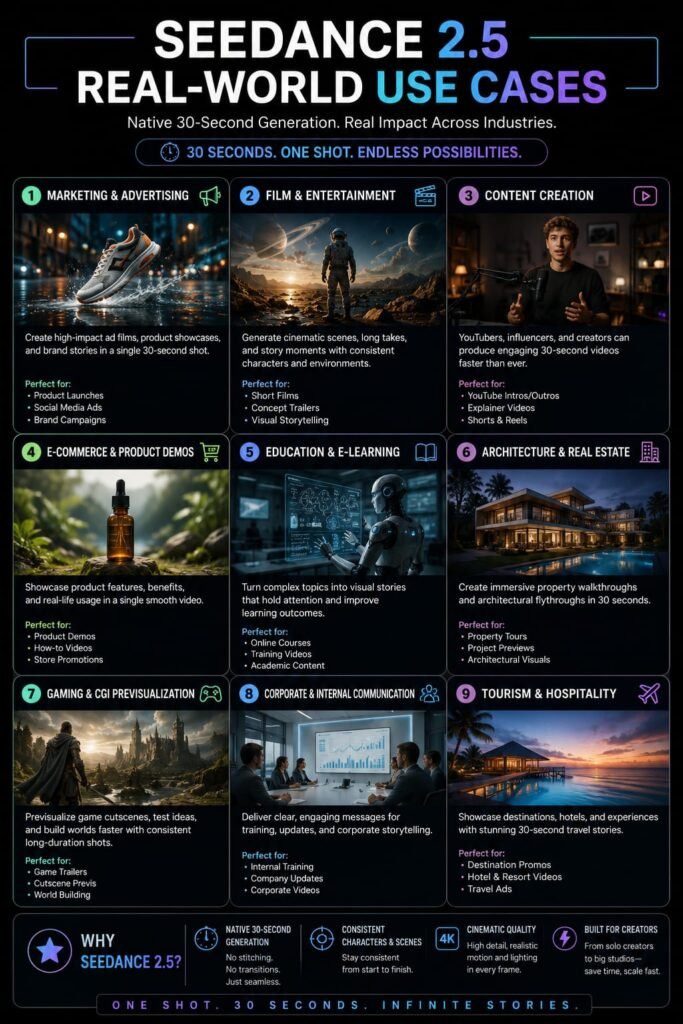
Complete Social Ad Spots
At 30 seconds, Seedance 2.5 covers the full runtime of a standard social ad unit. A brand team can generate a complete spot with product, talent, and motion in one pass, then use local editing to create variants for different markets or SKUs.
Product Visualization
E-commerce teams can feed the model product images from multiple angles, style references, and motion guidelines. The output places the product accurately in scene with correct lighting and scale—something earlier models struggled with when given only a single reference image.
Pre-Production Previz
Film and game teams can block out scenes in rough 3D, feed the blockout to Seedance 2.5 with style references, and receive a moving previz in minutes. This validates composition, pacing, and spatial relationships before committing to full production.
Short-Form Drama and Narrative
The 30-second length and strong consistency make it feasible to generate coherent narrative scenes rather than disconnected clips. For the booming short-form drama market, this reduces the stitching workload significantly.
Limitations and Concerns
No Free Tier
Unlike many competitors, Seedance 2.5 has no free quota. The barrier to entry is a minimum balance of approximately $28 or an existing resource pack. This makes casual experimentation expensive.
Hollywood Copyright Dispute
In March 2026, the Motion Picture Association sent ByteDance a cease-and-desist regarding Seedance 2.0’s training data. ByteDance froze global distribution of 2.0 outside China and added watermarking and IP guardrails. As of the 2.5 announcement, no settlement had been reached. For enterprise buyers needing documented IP provenance, this is a material risk.
50 References Can Conflict
A large reference set only helps if the model can actually follow it. Early user feedback suggests that with 50 inputs, some references may fight each other, producing outputs that prioritize one constraint while ignoring others. The feature is powerful but requires careful curation.
30 Seconds Still Has to Hold Together
A longer clip is only useful if consistency holds across the full duration. Creators want to see raw 30-second outputs, not polished promotional edits, before trusting the model for production work. Early enterprise demos have been promising, but independent benchmarks are still pending.
Frequently Asked Questions
What is Seedance 2.5?
Seedance 2.5 is ByteDance’s next-generation AI video generation model announced on June 23, 2026. It generates up to 30 seconds of native video in a single pass at 4K resolution, accepts up to 50 multimodal references, and can edit specific regions of finished footage without regenerating the entire clip.
When was Seedance 2.5 released?
Seedance 2.5 was announced on June 23, 2026, with enterprise beta access opening immediately. Public access via the Volcano Engine API and trial center opened on August 7, 2026. Third-party platforms are adding support through August and September 2026.
Is Seedance 2.5 free?
No. Seedance 2.5 has no free quota. Access on ByteDance’s official platform requires an account balance over ¥200 (approximately $28) or an existing Seedance 2.0 resource pack. Some third-party platforms like JXP and Morphic offer free trial credits for new users.
How long can Seedance 2.5 videos be?
Up to 30 seconds in a single continuous generation without stitching. You can also extend clips forward or backward for longer sequences. This is double the 15-second ceiling of Seedance 2.0 and Kling 3.0.
How many references can Seedance 2.5 use?
Up to 50 simultaneous multimodal references: 30 images, 10 video clips, and 10 audio clips. Audio-only reference is supported for the first time, allowing a music track to drive pacing and lip sync.
Can Seedance 2.5 edit existing videos?
Yes. Seedance 2.5 supports semantic local editing, allowing you to swap products, change backgrounds, replace clothing, remove objects, or relight scenes while keeping the original camera move, pacing, and unaffected elements intact.
Does Seedance 2.5 generate 4K?
Yes. Seedance 2.5 outputs native 4K resolution. Note that Seedance 2.0 was also upgraded to native 4K at the same announcement event, so 4K itself is not unique to 2.5—the unique upgrades are length, references, editing, and multilingual support.
Is Seedance 2.5 safe for commercial use?
Use cleared material and you are on solid ground. Seedance 2.0 faced copyright disputes with major studios, and ByteDance announced an updated licensing platform with 2.5. For commercial work, stick to your own assets, licensed content, or AI-generated faces, and avoid protected IP.
How much does a 30-second Seedance 2.5 clip cost?
At estimated 1080p Pro rates of $0.50 per second, a 30-second clip costs approximately $15. At 4K, the cost is higher. Reference inputs add roughly 50% of the output rate per second of input video. Exact 2.5 pricing is still rolling out across platforms.
Where can I use Seedance 2.5?
You can access Seedance 2.5 through ByteDance’s Volcano Engine API, Dreamina, and Jimeng, as well as third-party platforms including Tryonr, Morphic, Higgsfield, JXP, and Flova AI. Availability varies by region and platform.
My Genuine Conclusion: Should You Build Your Workflow Around Seedance 2.5 in 2026?
Seedance 2.5 is not just an incremental upgrade—it is a restructuring of what AI video generation can cover in a single pass. The 30-second native length eliminates the stitching problem that has slowed production teams since AI video became viable. The 50-reference system gives brand and film teams the control they need for consistent output. And the local editing feature finally makes AI video feel revisable rather than disposable.
But the model is not without caveats. The lack of a free tier raises the barrier to experimentation. The Hollywood copyright dispute creates uncertainty for enterprise buyers who need clean IP provenance. And the 50-reference system, while powerful, requires careful curation to avoid conflicting inputs.
My recommendation: If you are already generating AI video at volume and hitting the 15-second ceiling of current models, Seedance 2.5 is worth the investment. Start with a small test project on a third-party platform that offers trial credits. Generate one 30-second clip with your full reference set. Test the local editing on a detail you would normally have to regenerate. If the output holds together across the full duration, you have your answer—and likely a new default model.
Seedance 2.0 isn’t just about video quality—the platform you use to access it can make a big difference to the overall cost. If you’re planning to generate a lot of videos with Seedance 2.0, it’s worth comparing the different pricing models, credit systems, and cost per generation before choosing a platform. For a detailed breakdown, check out our [Higgsfield AI pricing guide], where we compare its plans, credits, and the real cost of using Seedance 2.0.
Related Reads:
What Is Lovable AI? The Complete Guide to the AI App Builder Everyone’s Talking About
Is Lovable AI Free? Here’s What You Actually Get
Claude Pro vs ChatGPT Plus: The Real Difference Between These $20 AI Plans
How to Fix AI Image Generator Deformities in Fingers, Toes, and Other Anomalies
What Is Meta AI Muse Spark? The Complete 2026 Guide to Meta’s Flagship AI Model
Kimi K3 Explained: Inside Moonshot AI’s Record-Breaking Open Mode
Best AI App Builder in 2026: 10 Top Tools to Build an App Without Coding
Seedance 2: Inside ByteDance’s Most Realistic AI Video Model Yet (2026)