
Replit vs Lovable compared: pricing, coding flexibility, backend support, and ease of use to help you pick the right AI app builder in 2026.
Both promise the same basic thing describe an app, watch it get built but Replit and Lovable arrive at that promise from completely different directions. One grew out of a full, browser-based coding environment used by millions of developers long before AI entered the picture. The other was built from day one around a single idea: full-stack web apps generated from a conversation, with as little manual configuration as possible.
That difference in origin shapes almost everything about how Replit vs Lovable actually plays out in practice — how much control you get, how steep the learning curve is, and what your project looks like six months in. This guide breaks down both platforms in detail: pricing, how each one actually builds your app, backend and database support, code ownership, collaboration tools, and which one fits your specific project. By the end, you’ll know which platform deserves your time.
Replit vs Lovable: The Quick Answer
Replit is a full browser-based development environment with an AI coding agent layered on top, offering multi-language support and deep technical control, best suited to developers and technically comfortable builders. Lovable is a purpose-built AI app generator focused specifically on full-stack web apps from natural language, with a simpler, more guided experience best suited to non-technical founders and rapid MVP building.
If you want maximum flexibility and don’t mind a steeper learning curve, Replit generally wins. If you want the fastest, most guided path from a plain-English description to a working web app, Lovable generally wins. The rest of this guide explains exactly why.
What Is Replit? A Quick Overview
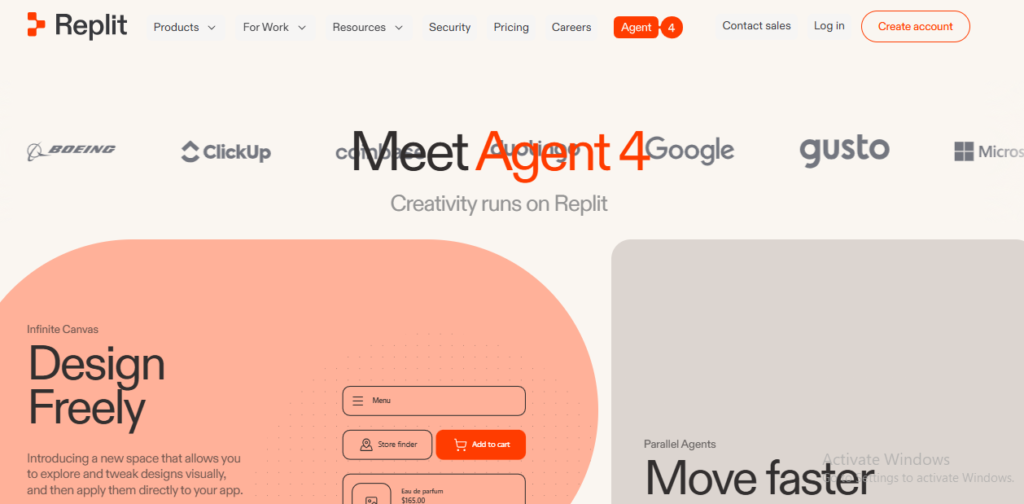
Replit started as a browser-based coding environment years before AI app builders became a category of their own, and that history still shapes the product today. At its core, Replit is a full cloud development environment supporting Python, JavaScript, TypeScript, Java, C++, Go, and many other languages — that added an AI layer, Replit Agent, capable of building, debugging, and deploying full-stack applications from natural-language prompts.
Because Replit was a genuine coding platform first, it retains that flexibility even as its AI capabilities have matured. You can let the Agent handle an entire build autonomously, or drop into the underlying code yourself at any point — a hybrid approach that appeals particularly to developers who want AI assistance without giving up direct access to their codebase.
What Is Lovable? A Quick Overview
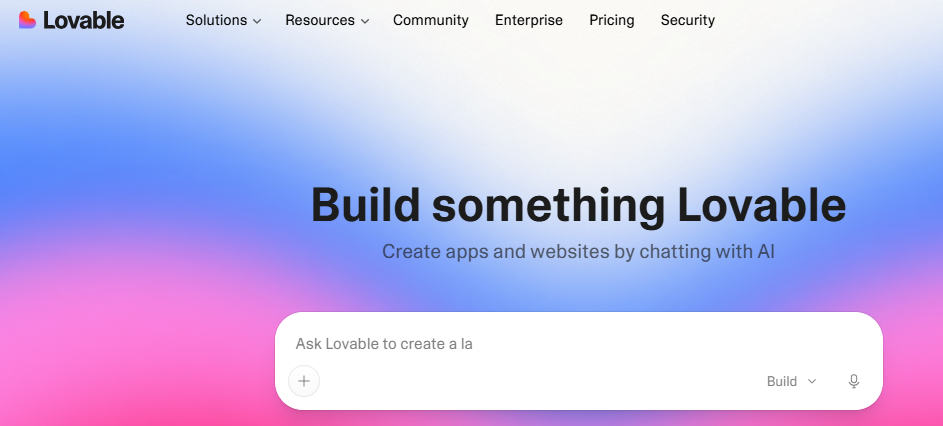
Lovable, by contrast, was built specifically around AI-first app generation rather than evolving from an existing coding platform. You describe an app in plain English, and Lovable generates a complete full-stack application front end, backend, database, and authentication — using a two-stage workflow: a Plan mode that maps out the app’s structure before any code is written, followed by a Build mode that generates the actual application.
Lovable’s core technical stack centers on React and TypeScript for the front end, with Supabase handling the database and authentication layer, and generated code syncing directly to GitHub. The platform is designed to minimize the number of decisions a non-technical user needs to make along the way.
Replit vs Lovable Pricing Compared
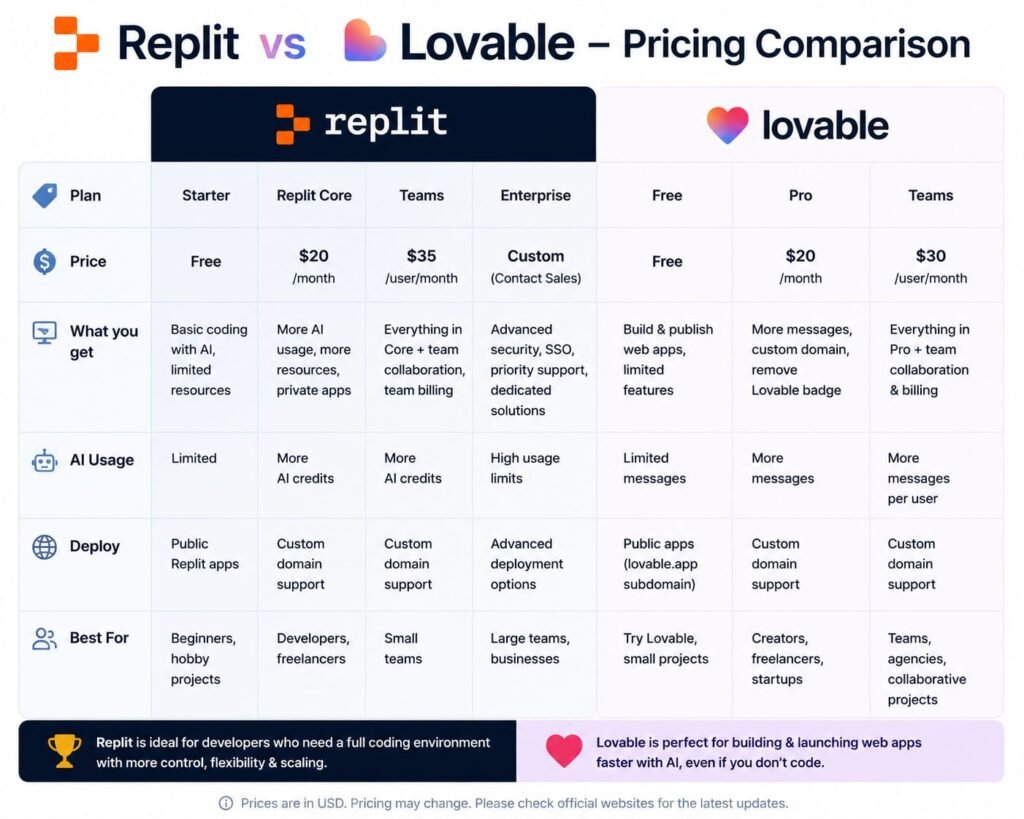
Featured snippet answer: Replit’s Core plan costs $20/month billed annually (or $25/month billed monthly), including roughly $20-25 in monthly usage credits, while Lovable’s Pro plan runs around $25/month for roughly 100 monthly credits both platforms use a subscription-plus-credits model, though Replit’s effort-based credit pricing tends to be less predictable for complex, code-heavy tasks.
Replit’s Pricing Structure
Replit’s current tiers, as of 2026, are Starter (free), Core (~$20-25/month), Pro (~$100/month flat for up to 15 team members, replacing the older Teams plan in February 2026), and Enterprise (custom). The free Starter plan includes basic AI features, community/public projects, and limited compute — enough for learning and small experiments, but restrictive for anything you intend to actually ship. Core unlocks Replit Agent more fully, a monthly credit allowance, up to five collaborators, and Replit Deployments for persistent hosting.
Replit’s credit system uses what the company calls “effort-based pricing,” where each AI agent action — a tool call, a file write, a documentation fetch — is billed according to actual computational complexity rather than a flat per-checkpoint rate. In practice, a simple edit might cost a fraction of a credit, while scaffolding a full authentication flow can run into the hundreds of credits. Heavy daily use has been estimated at anywhere from $5 to $20 per day in credit consumption on top of the base Core subscription.
Lovable’s Pricing Structure
Lovable’s tiers are Free ($0), Pro (~$25/month for around 100 monthly credits), Business (~$50/month, adding team features like SSO), and Enterprise (custom). Like Replit, different types of requests consume different amounts of credits — a small styling tweak costs relatively little, while a complex, app-wide change or a new integration costs meaningfully more.
Which Is Cheaper in Practice?
At the entry level, the two are close enough that price alone shouldn’t decide your choice both land in the $20-25/month range for their core paid tier. Where they diverge is predictability: Lovable’s credit costs tend to be more consistent because its scope (full-stack web apps specifically) is narrower, while Replit’s effort-based pricing can vary more widely depending on how complex and code-intensive your specific tasks are, since Replit supports a much broader range of technical work beyond simple app generation.
Replit vs Lovable: How Each One Actually Builds Your App
The core building experience is where the two platforms feel most different day to day.
Replit’s Agent-in-an-IDE Approach
Replit Agent operates inside what is fundamentally still a full code editor. You can watch it work, review and edit the code it generates directly, run and test the application yourself, and jump between AI-driven changes and manual coding freely. This makes Replit feel more like pairing with an AI developer inside your own workspace than handing off the entire process to an external system.
Lovable’s Plan-Then-Build Workflow
Lovable’s two-stage process is designed to catch misunderstandings early you see the AI’s plan for your app’s structure before it writes any code, reducing the chances of a large, wasted generation based on a misread request. The resulting code is visible and editable, but the overall experience leans more toward “describe and review” than “collaborate directly inside a live coding environment” the way Replit does.
Example: A developer wanting to build a custom internal tool while retaining the ability to hand-write a tricky piece of business logic midway through would likely feel more at home in Replit’s live-editing environment. A non-technical founder who just wants to describe an app and refine it through further prompts, without touching code directly, would likely find Lovable’s guided flow more comfortable.
Coding Language and Flexibility: Replit’s Clear Edge
This is one of the most significant practical differences between the two platforms.
Featured snippet answer: Replit supports a wide range of programming languages including Python, JavaScript, TypeScript, Java, C++, and Go — making it suitable for general software development beyond web apps, while Lovable is scoped specifically to React and TypeScript web applications, making it more focused but far less flexible for non-web projects.
If your project is anything other than a standard web application a Python data pipeline, a script-based automation tool, a backend service in a language other than JavaScript — Replit is the only one of the two platforms that can genuinely handle it. Lovable’s tight focus on React-based web apps is a strength for its intended use case, but it’s a hard ceiling if your project needs something outside that scope.
Backend and Database: Replit vs Lovable
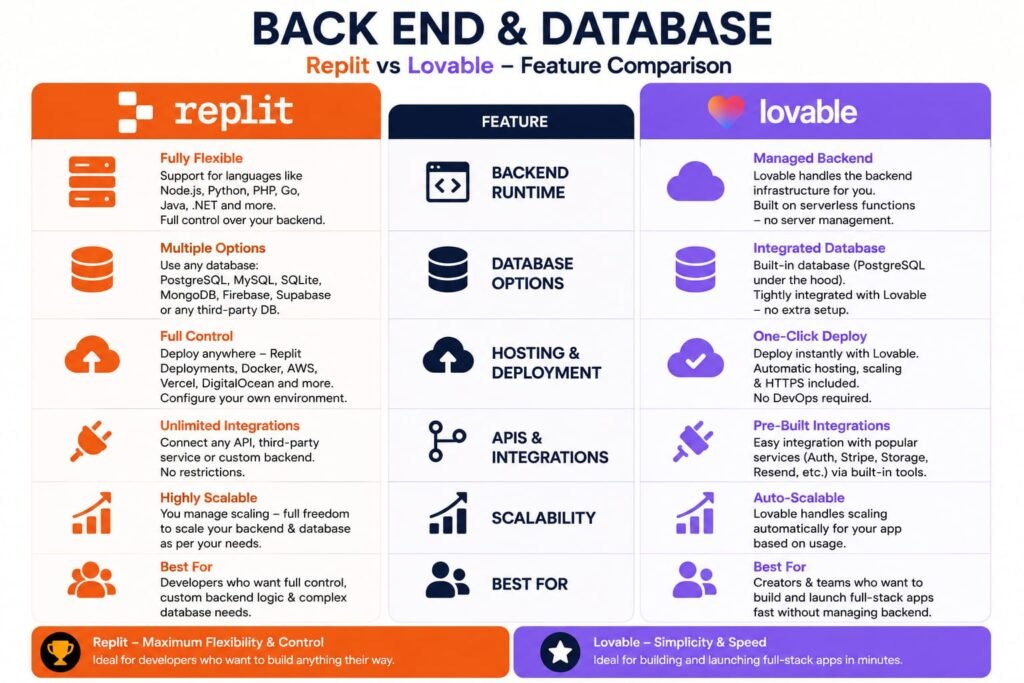
Both platforms include backend capabilities, but they differ in depth and flexibility.
Replit offers its own integrated Replit Database for smaller projects, along with support for PostgreSQL hosting and the ability to connect external databases for more advanced needs giving you meaningful choice in how your backend is structured.
Lovable’s backend runs specifically through Supabase, handling your database, authentication, and file storage in a more opinionated, pre-configured way. This requires less setup decision-making on your part, but it also means you’re working within Supabase’s specific structure rather than choosing your own backend infrastructure.
The tradeoff: Lovable’s approach is faster to get started with and requires fewer decisions; Replit’s approach offers more control and flexibility for developers who have specific backend requirements or preferences.
Ease of Use: Which Platform Is Better for Non-Technical Users?
Featured snippet answer: Lovable is generally considered more approachable for non-technical users, thanks to its guided Plan-then-Build workflow and narrower focus on web app generation specifically. Replit’s broader scope as a full development environment gives it a steeper learning curve, though its AI Agent can still build functional apps for non-developers without requiring them to write code directly.
Both platforms are usable without a coding background, but the experience differs. Lovable’s focus and structure mean fewer decisions and a more predictable path from prompt to finished app. Replit’s flexibility is a double-edged sword for beginners it’s genuinely powerful, but the presence of a full code editor, multiple language options, and more granular infrastructure choices can feel overwhelming if you just want to describe an app and have it appear.
Code Ownership and Export: What You Actually Keep
Both platforms score well here relative to some competitors, but with different mechanics.
Lovable syncs generated code directly to GitHub as standard React and TypeScript, giving you a portable, real codebase you can hand off to a developer or continue building elsewhere at any point.
Replit also allows code export, and because it’s fundamentally a coding environment rather than a black-box generator, you have direct, continuous access to every file it creates throughout the entire build process arguably an even more transparent form of ownership, since there’s no meaningful separation between “the AI’s version” and “your version” of the code at any point.
Collaboration and Team Features
For teams evaluating either platform, collaboration capabilities differ meaningfully by tier.
Replit’s Core plan supports up to five collaborators, while its Pro plan (replacing the older Teams plan in February 2026) supports up to 15 team members with pooled credits, role-based access control, and centralized billing features aimed squarely at development teams working together in a shared environment.
Lovable’s Business plan adds team-oriented features including single sign-on, positioned more around organizational access control than the granular collaborative coding experience Replit supports.
The takeaway: Replit’s collaboration tools lean into real-time, multiplayer coding genuinely useful for a team of developers working on the same codebase simultaneously. Lovable’s team features are more about shared account access and governance than collaborative live editing.
Deployment and Hosting
Both platforms include deployment as part of the core experience, removing the need for separate hosting setup.
Replit Deployments supports multiple deployment types autoscaling apps, static sites, and reserved VMs giving you meaningful control over how your app is actually hosted and how it scales under load.
Lovable offers one-click deployment with custom domain support on paid plans, a simpler, more streamlined path that requires fewer decisions but offers less granular control over the underlying hosting infrastructure.
Replit vs Lovable for Specific Use Cases
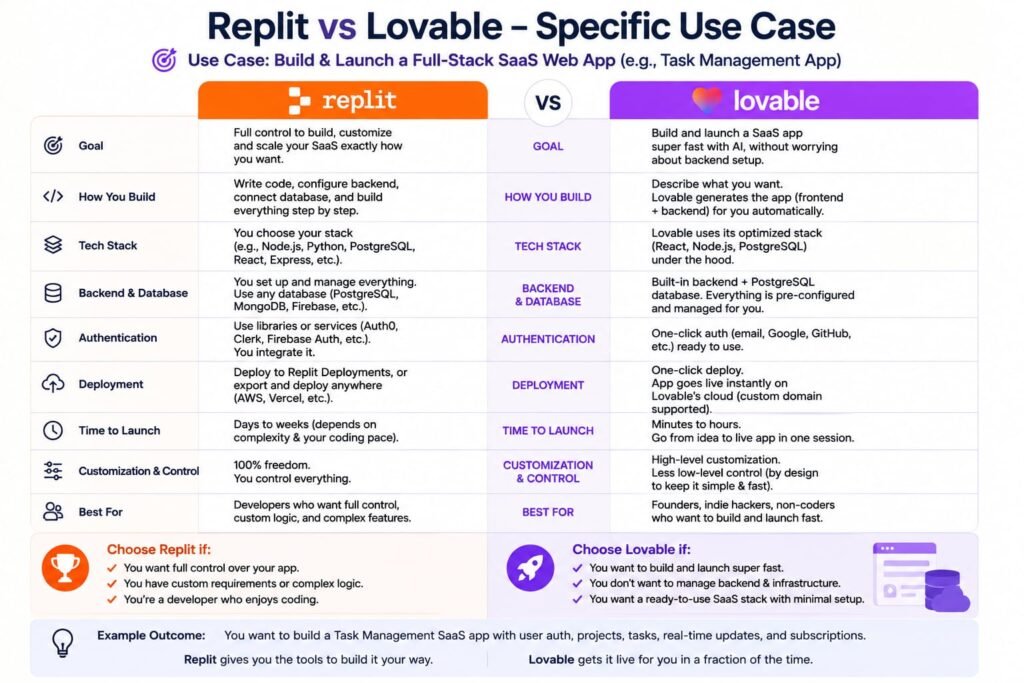
Bringing everything together, here’s how the two platforms stack up depending on what you’re actually building:
Building a SaaS MVP as a non-technical founder: Lovable’s guided workflow and Supabase-backed simplicity make it the faster, lower-friction choice.
Building a custom internal tool with specific technical requirements: Replit’s language flexibility and direct code access give it the edge for anything beyond a standard web app pattern.
Learning to code while building something real: Replit’s full development environment, spanning multiple languages and a genuine code editor, is a stronger foundation for anyone who also wants to build coding skills alongside their project.
A quick web app prototype to test with users: Both work well here, though Lovable’s narrower focus tends to get you to a clickable result slightly faster for standard web app patterns.
A data-heavy or backend-specific project: Replit’s support for Python and direct database flexibility makes it the more natural fit outside of standard web app development.
A team of developers collaborating on one codebase: Replit’s multiplayer, real-time coding environment is purpose-built for this in a way Lovable isn’t.
Frequently Asked Questions
Is Replit or Lovable better for beginners?
Lovable is generally more approachable for complete beginners, thanks to its narrower focus and guided Plan-then-Build workflow. Replit is more powerful but has a steeper learning curve due to its full code editor and broader technical scope.
Which is cheaper, Replit or Lovable? Both land in a similar $20-25/month range for their entry-level paid tier. Lovable’s credit costs tend to be more predictable due to its narrower scope, while Replit’s effort-based pricing can vary more depending on task complexity.
Can Replit and Lovable both build mobile apps?
No. Both platforms are focused on web application generation. Neither produces native iOS or Android apps if mobile output is your priority, a dedicated tool like Rork or FlutterFlow is a better fit for either platform.
Does Lovable support programming languages other than React and TypeScript?
No, Lovable’s core generation is scoped specifically to React and TypeScript for web applications. Replit, by contrast, supports Python, JavaScript, Java, C++, Go, and several other languages.
Which platform gives me more control over my code?
Replit offers more direct, continuous control since it’s a full code editor with the AI operating inside it. Lovable also allows code export and GitHub sync, but the overall workflow leans more toward reviewing AI-generated output than actively co-editing it in real time.
Is Replit good for non-developers, or only for people who can code?
Replit’s AI Agent can build functional apps for non-developers without requiring manual coding, but the surrounding environment — a full code editor, multiple language options, infrastructure choices is more geared toward technically comfortable users than Lovable’s more guided experience.
Which is better for a SaaS MVP, Replit or Lovable?
Lovable is generally the faster, more guided path for a standard SaaS MVP, thanks to its pre-configured Supabase backend and narrower focus. Replit is a better fit if your MVP has specific technical requirements outside standard web app patterns.
Do Replit and Lovable both offer team collaboration features?
Yes, though differently. Replit supports real-time, multiplayer collaborative coding with role-based access on its Pro plan. Lovable’s Business plan adds team account features like SSO, but doesn’t offer the same live, collaborative coding experience.
Which platform has more predictable pricing?
Lovable’s pricing tends to be more predictable due to its narrower, web-app-specific scope. Replit’s effort-based credit system for Agent usage can produce more variable costs, particularly for complex, code-intensive tasks.
Can I switch from Lovable to Replit (or vice versa) mid-project?
It’s possible but not seamless. Since both platforms allow code export, you can technically move your codebase, but you’d lose access to each platform’s specific AI-assisted workflow and would need to continue development manually or re-import the project into the new platform’s environment.
My Final Thoughts: Replit vs Lovable — Which Should You Choose?
The Replit vs Lovable decision ultimately comes down to a simple question: do you want a full development environment with an AI layer, or an AI-first app generator with a narrower, more guided focus? Replit wins on flexibility, language support, and direct code control genuinely valuable if your project needs more than a standard web app, or if you want to build coding skills alongside your project. Lovable wins on approachability and speed for exactly the use case it was built around: getting a non-technical founder from an idea to a working full-stack web app as quickly and painlessly as possible.
If you’re still unsure which fits your project, the fastest way to decide is a direct test: describe the same simple version of your app idea on both platforms’ free tiers, and see which one actually feels right for how you think and build. Both are free to start, so that comparison costs you nothing but a bit of time and it’ll tell you more than any single review, including this one.
Related Reads-
What Is Lovable AI? The Complete Guide to the AI App Builder Everyone’s Talking About
Is Lovable AI Free? Here’s What You Actually Get
Claude Pro vs ChatGPT Plus: The Real Difference Between These $20 AI Plans
How to Fix AI Image Generator Deformities in Fingers, Toes, and Other Anomalies
What Is Meta AI Muse Spark? The Complete 2026 Guide to Meta’s Flagship AI Model
Kimi K3 Explained: Inside Moonshot AI’s Record-Breaking Open Mode
Best AI App Builder in 2026: 10 Top Tools to Build an App Without Coding
Bolt AI App Builder: The Complete Guide to Building Apps in Your Web Browser
Higgsfield AI Pricing in 2026: Every Plan, Credit Cost, and What You Actually Get
Base 44 Pricing in 2026: Every Plan, Credit Cost, and Hidden Fee Explained
Base44 Reviews 2026: What Real Users Actually Think Before You Build
FlutterFlow AI App Builder: The Complete 2026 Guide to Building Real Native Apps
Kimi AI App: The Complete Guide to Download, Features, and How It WorksIs
Kimi AI vs ChatGPT: Which AI Assistant Actually Wins in 2026?
Moonshot AI Kimi K2 Explained: The Open-Source Model Series That Changed AI in 2026
Rocket AI App Builder: The Complete Guide to Solve, Build, and Intelligence
What LLM Does Replit Use? A Complete Guide to Replit’s AI Models, Agents, and Integrations in 2026