

What LLM does Replit use? Discover the AI models behind Replit Agent, Assistant, and Design Mode—plus agents, integrations, and pricing in 2026.
If you have ever watched Replit’s AI Agent scaffold an entire full-stack app from a single sentence, you have probably asked yourself the same question: what llm does replit use to make that happen? Is it ChatGPT? Claude? Something built in-house? And why does one feature feel lightning-fast while another seems to think for minutes before responding?
The answer is not simple—and that is actually Replit’s biggest strength. Unlike competitors that bet everything on a single AI provider, Replit runs a carefully orchestrated multi-model system. Different large language models power different features, each chosen for the specific job it does best. Understanding this architecture matters because it explains why Replit Agent can build a SaaS dashboard in 45 minutes, why the Assistant answers routine questions instantly, and why your monthly bill can spike unexpectedly if you do not know which model is doing the work.
In this guide, we will break down every LLM behind Replit’s 2026 product lineup, explain how the multi-agent system coordinates them, detail the integrations that extend their capabilities, and give you a practical framework for managing costs. Whether you are evaluating Replit against Cursor, trying to optimize your credit usage, or simply curious about the technology, this is the most complete answer available.
The Short Answer: Replit Uses Multiple LLMs
Replit does not rely on a single large language model. Instead, it strategically deploys multiple AI models across its platform:
| Replit Feature | AI Model Used | Provider |
|---|---|---|
| Replit Agent | Claude Sonnet 4.5 | Anthropic |
| Replit Assistant | Gemini 1.5 Flash | |
| Replit Design | Gemini 3 | |
| Code Completion (Free) | replit-code-v1.5-3b | Replit (Open Source) |
| User-Built Apps | GPT-4o, Claude, Gemini | Via AI Integrations |
So, is Replit powered by ChatGPT? No. The platform’s flagship Agent feature runs on Anthropic’s Claude family. However, developers can access OpenAI’s GPT-4o when building their own applications through Replit’s AI Integrations.
This multi-model approach is deliberate. Each LLM serves a specific purpose based on its strengths. Claude handles complex reasoning and code generation. Gemini Flash delivers speed for quick interactions. Replit’s own open-source model provides cost-effective autocomplete for free users.
Replit Agent: Powered by Anthropic’s Claude
The Replit Agent is the platform’s most powerful AI feature. It can build complete applications from natural language prompts, handle multi-file architecture decisions, and even test its own code in a sandboxed browser. Behind this capability sits Claude, Anthropic’s advanced language model.
Why Replit Chose Claude
Replit evaluated several AI models before selecting Claude. The decision came down to performance on code generation and editing tasks. According to Michele Catasta, President of Replit: “Claude 3.5 Sonnet delivered such a jump in the ability to code and reason that Replit accelerated its product roadmap.”
Several factors made Claude the ideal choice:
- Superior code generation: Claude writes cleaner, more functional code than alternatives
- Request chaining: The model handles multiple operations simultaneously
- Self-correction: Claude debugs its own code without getting stuck in loops
- Complex reasoning: It understands project context and makes architectural decisions
The Replit AI model runs on Google Cloud’s Vertex AI infrastructure, ensuring reliable performance for millions of users worldwide.
How Claude Evolved Within Replit
Replit has continuously upgraded its Agent to newer Claude versions:
- September 2024: Agent launched with Claude 3.5 Sonnet
- October 2024: Upgraded to enhanced Claude 3.5 Sonnet with computer use
- February 2025: Agent v2 released with Claude 3.7 Sonnet
- May 2025: Integration with Claude Opus 4 and Sonnet 4
- September 2025: Claude Sonnet 4.5 became the primary model
Each upgrade brought measurable improvements. With Claude Sonnet 4.5, Replit reported a code editing error rate drop from 9% to 0% on internal benchmarks.
The Multi-Agent Architecture
Replit does not use Claude as a single monolithic agent. Instead, the platform built a sophisticated multi-agent system:
- Manager Agent: Oversees the entire workflow and coordinates tasks
- Editor Agents: Handle specific coding operations and file modifications
- Verifier Agent: Checks code quality and interacts with users for feedback
This architecture improves reliability significantly. When one agent encounters an issue, others can compensate. The verifier agent specifically ensures users stay involved throughout the development process.
Replit Assistant: Speed from Google’s Gemini
While Claude handles complex Agent tasks, Google’s Gemini family serves speed-critical features. Replit leverages different Gemini models for the Assistant and the newer Design Mode.
Gemini 1.5 Flash for Replit Assistant
Replit Assistant works alongside the main Agent, helping users improve existing code, fix errors, and add new features. Speed matters most here, and Gemini 1.5 Flash delivers exactly that. The model responds quickly to simple queries without the overhead of larger models.
According to Google Cloud’s case study, Replit specifically chose Gemini Flash for its efficiency handling high-volume, straightforward requests cost-effectively.
Gemini 3 Powers Replit Design
November 2025 introduced Design Mode, Replit’s fastest way to create websites. This feature runs on Google’s newest Gemini 3 model. Design Mode creates interactive mockups and static sites in under two minutes, understanding visual concepts like layout, spacing, color harmony, and typography that pure code models miss.
The feature serves as an alternative to tools like Figma Make or Magic Patterns, letting product managers and designers create clickable prototypes without engineering support.
Replit’s Own Open-Source Code Models
While Claude powers the Agent, Replit developed proprietary models for other features. These open-source LLMs demonstrate the company’s commitment to AI independence.
Why Replit Built Its Own LLMs
Three core reasons drove the decision:
- Customization: Generic models do not understand Replit-specific patterns. Custom models excel at web languages popular on the platform, including JavaScript React (JSX) and TypeScript React (TSX).
- Reduced Dependency: Relying solely on external providers creates risk. Internal models give Replit flexibility and control.
- Cost Efficiency: A student coding on a phone in India should access the same AI as a Silicon Valley developer. Smaller, efficient models make this financially possible.
replit-code-v1.5-3b: The Current Production Model
Released in October 2023, this model now powers free code completion for all users:
- Parameters: 3.3 billion
- Training Data: 1 trillion tokens
- Languages Supported: 30 programming languages
- Training Hardware: 128 NVIDIA H100-80GB GPUs
This became the first model trained on H100 GPUs released as open source. Anyone can download it from Hugging Face for custom applications.
Replit Agent 3: The Autonomous Coding Engine
Replit Agent 3, launched in September 2025, is the event that shifted Replit from “online editor” to “AI software platform.” It introduced four signature capabilities that define the current experience:
Self-Testing Loop
Agent 3 opens the running app in a sandboxed Chromium browser, simulates clicks, typing, dropdowns, and form fills, then records replay video and patches its own bugs based on what it observed.
Autonomy Selector
Four levels—Low, Medium, High, and Max—scale the agent from a 5-minute helper to a 200-minute autonomous developer. This lets you control how independently the agent works before checking back in.
Agent Spawning Workflow Builder
Takes natural language like “every Friday, summarize our Slack channels and email the team” and produces a runnable cron-scheduled multi-agent system.
Model Selector (July 2026 Update)
As of July 2026, users can now choose the primary model Agent uses for a task. Select Lite, Economy, or Power, then choose from available models for that mode. Lite is now available wherever you can use Agent, including in mobile apps.
This is a major cost-control feature. Power mode uses the most capable models (likely Claude Sonnet 4.5 or GPT-4o) but burns credits faster. Economy mode uses faster, cheaper models for straightforward tasks.
AI Integrations: Access Multiple LLMs for Your Apps
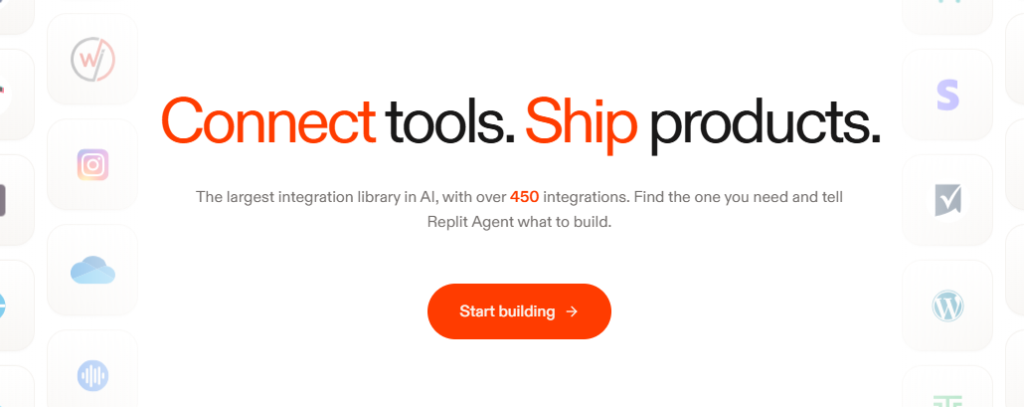
Replit does not just use AI internally. The platform provides developers managed access to external LLMs through AI Integrations, eliminating the friction of managing API keys and credentials.
Supported AI Providers
- OpenAI: GPT-4o, o3, and other models
- Anthropic: Claude model family
- Google: Gemini models
- OpenRouter: Access to Meta Llama, Mistral, DeepSeek, and more
- Perplexity: AI-powered search with citations
- Mistral AI: Fast, efficient language models for NLP tasks
How It Works
Replit handles credential management automatically. Developers simply describe what they want, and the Agent builds using the appropriate API. Usage charges appear on your Replit account at public API prices—no separate billing relationships required. Alternatively, developers can provide their own API keys.
Replit Integrations: Connectors, Services, and MCP
Beyond AI models, Replit supports four types of integrations that extend what its agents can do:
Replit Managed Integrations
Built-in features requiring no setup:
- Replit Database: Managed PostgreSQL for relational data
- Replit App Storage: Cloud storage for images, videos, and files
- Replit Auth: Native authentication so people can sign in with Replit
- Replit Domains: Custom domain configuration
Connectors
First-party integrations where you sign in once, and Agent can read and write to services directly from chat:
- Google (OAuth, Sheets, Drive)
- Stripe (payments)
- Discord (messages, server management)
- HubSpot (CRM data)
- Coinbase (crypto payments)
- Zillow (real estate data)
External Integrations
Trusted third-party services requiring API keys stored securely in Secrets:
- Workato (automation recipes)
- Airtable, Notion (custom API connections)
- Slack/Discord webhooks (manual Express.js workarounds)
Agent Services
Paid third-party APIs Agent uses behind the scenes—no API keys required, billed to Replit credits:
- Brave Image Search: Web image search
- ElevenLabs: Text-to-speech and voice generation
- Google Gemini Image Generation (Nano Banana): AI image generation
MCP Servers (July 2026)
Eligible workspaces can now connect to Supabase, Statsig, Calendly, and Braintrust through the pre-listed MCP server catalog, extending Agent’s capabilities through the Model Context Protocol.
Replit Pricing and How AI Models Affect Your Bill
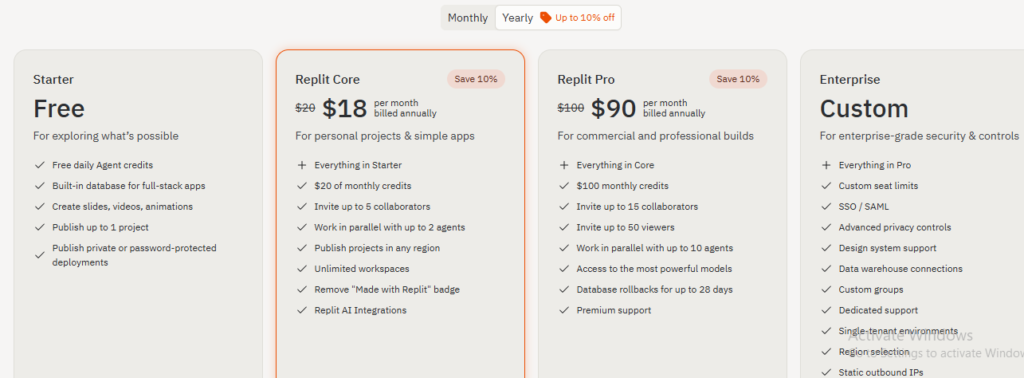
Understanding what llm does replit use is essential because different models consume credits at different rates.
Pricing Tiers (July 2026)
| Plan | Monthly Price | Credits | Best For |
|---|---|---|---|
| Starter | Free | Daily caps | Beginners, testing |
| Core | $20/mo (annual) | $20/mo credits | Solo developers |
| Pro | $100/mo | $100/mo credits | Teams up to 15 |
| Enterprise | Custom | Custom | Large organizations |
How Credits Map to Models
Replit uses “effort-based pricing.” Complex tasks with Power mode (Claude Sonnet 4.5) consume significantly more credits than Economy mode (Gemini Flash or lighter models).
- Simple landing page: ~$2.50 in credits, 8 minutes
- Task management app with auth: ~$12 in credits, 45 minutes
- Complex API integration: ~$18 in credits, 2 hours
Critical cost insight: The model selector introduced in July 2026 is your primary cost-control tool. Use Lite/Economy for simple edits and reserve Power mode for architectural decisions. A single heavy autonomous build can exhaust a Core plan’s entire monthly credit allowance.
Replit vs Competitors: How the AI Models Compare
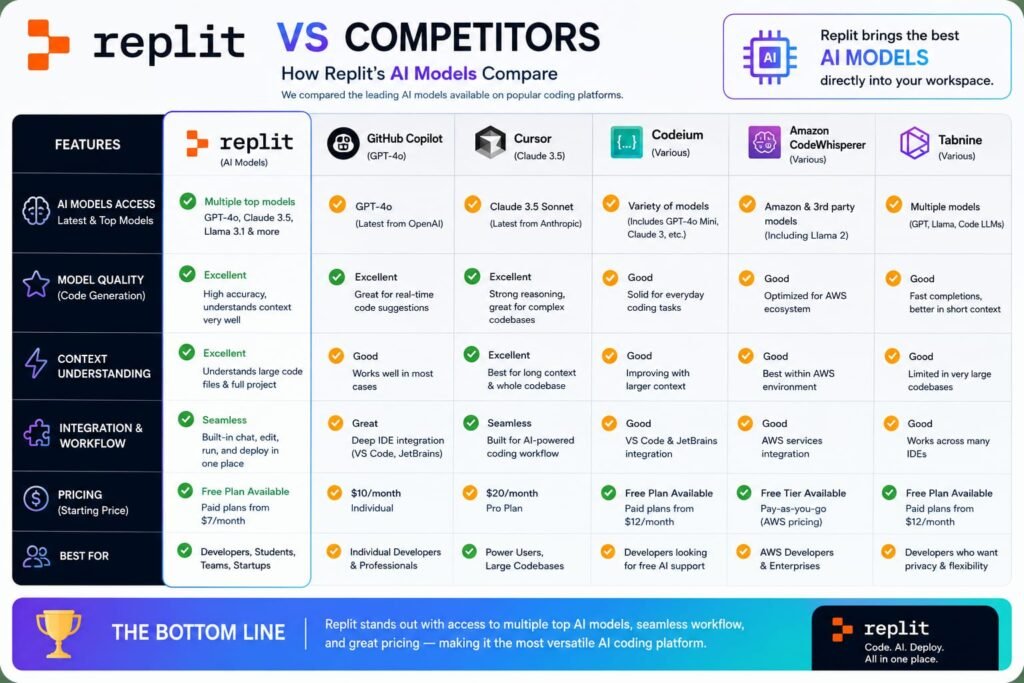
| Feature | Replit | Cursor | GitHub Copilot |
|---|---|---|---|
| Primary AI Models | Claude, Gemini, Proprietary | Claude, GPT-4 | OpenAI Codex, GPT-4 |
| Target Users | Beginners to professionals | Experienced developers | Developers in existing IDEs |
| Environment | Browser-based full IDE | Desktop VS Code fork | IDE plugin/extension |
| Deployment | Built-in hosting included | Manual setup required | Not included |
| Free AI Tier | Yes (proprietary model) | Limited trial only | Limited free access |
| Code Ownership | Full code access | Full code access | Full code access |
For professional developers comfortable with traditional workflows, Cursor excels. For end-to-end development with deployment, Replit provides more value. Copilot suits developers who want AI assistance in familiar tools.
The Evolution of Replit’s AI: A Timeline
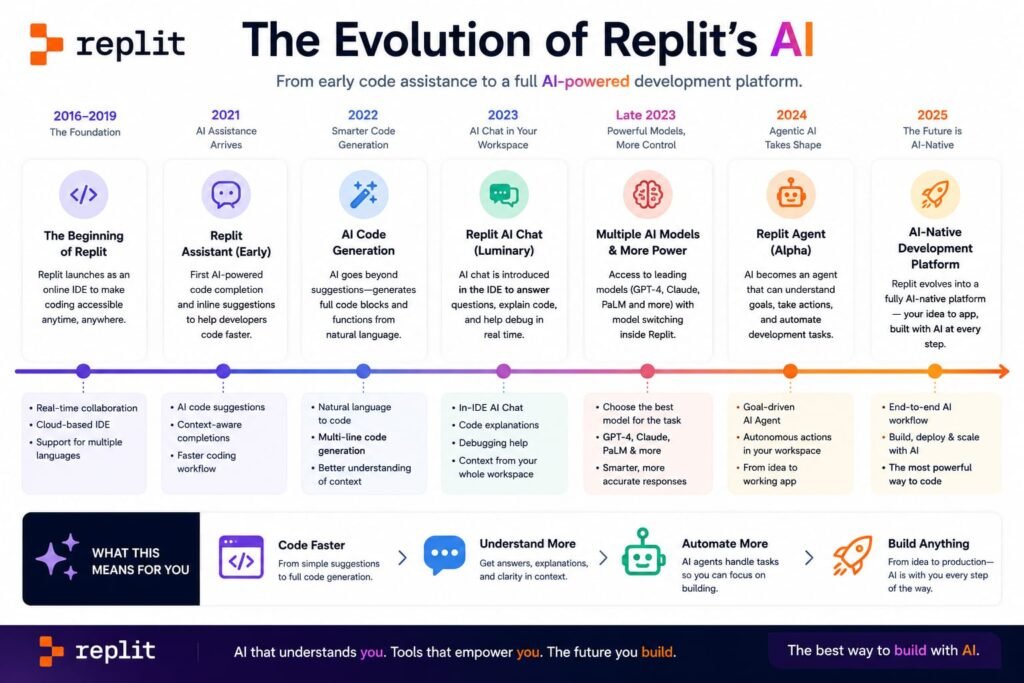
2022
- October: Ghostwriter launches with CodeGen-based models
2023
- April: Replit announces internal LLM training capabilities
- May: Releases replit-code-v1-3b as open source
- October: Launches replit-code-v1.5-3b; makes AI free for all users
2024
- June: Begins Claude 3.5 Sonnet integration
- September: Replit Agent launches powered by Claude 3.5 Sonnet
2025
- February: Agent v2 with Claude 3.7 Sonnet
- May: Claude Opus 4 and Sonnet 4 integration
- September: Claude Sonnet 4.5 becomes primary model
- November: Design Mode powered by Gemini 3
2026
- January: Audio support in AI integrations, web search in Agent automations
- February: Pro plan launched, replacing Teams
- July: Model selector released; users can choose Lite, Economy, or Power modes
Frequently Asked Questions
What LLM does Replit Agent use?
Replit Agent currently uses Claude Sonnet 4.5 by Anthropic, running on Google Cloud’s Vertex AI infrastructure. Earlier versions used Claude 3.5 Sonnet, 3.7 Sonnet, and Opus 4.
Is Replit powered by ChatGPT?
No. Replit does not use ChatGPT for its core features. The Replit Agent runs on Claude by Anthropic. However, developers can access OpenAI’s GPT-4o through AI Integrations when building their own applications.
Does Replit have its own AI model?
Yes. Replit developed and released replit-code-v1.5-3b, an open-source model with 3.3 billion parameters trained on 1 trillion tokens. It powers free code completion and is available on Hugging Face.
Can I choose which AI model Replit Agent uses?
Yes. As of July 2026, Replit allows users to select Lite, Economy, or Power modes, with specific model choices within each tier. This helps balance capability against credit consumption.
What is the difference between Replit Agent and Assistant?
Agent uses Claude Sonnet 4.5 for complex, autonomous full-stack development. Assistant uses Gemini 1.5 Flash for quick, lightweight code help and routine queries.
What integrations does Replit support?
Replit supports Replit-managed integrations (database, auth, storage), first-party connectors (Google, Stripe, Discord, HubSpot), external integrations requiring API keys (OpenAI, Workato, Airtable), and Agent services (Brave, ElevenLabs, Gemini image generation).
How much does Replit Agent cost?
Replit Agent is available on the free Starter plan with daily credit limits. Paid plans start at $20/month (Core) with $20 in monthly credits. Heavy Agent usage can consume credits rapidly, with complex builds costing $12–$18 per session.
Is Replit’s AI free?
Basic AI features including code completion are free for all users, powered by Replit’s open-source model. Advanced Agent capabilities require paid plans starting at $20 per month.
What happened to Replit Ghostwriter?
Ghostwriter was Replit’s original AI assistant, now superseded by Agent 3. Agent 3 can work autonomously for up to 200 minutes, test and fix its own code, and spawn subagents for specialized tasks.
Can I use GPT-4 with Replit?
Yes. Through Replit AI Integrations, you can access OpenAI’s GPT-4o and other models for your own applications. Replit handles credential management, or you can provide your own API keys.
Final Conclusion: Why Replit’s Multi-Model Strategy Matters
So what llm does replit use? The honest answer is: the right one for the job. Replit’s multi-model approach is not marketing complexity—it is a deliberate architectural choice that optimizes performance, manages costs, and reduces dependence on any single provider.
Claude Sonnet 4.5 powers the heavy lifting of autonomous app development. Gemini Flash handles the quick, high-volume Assistant interactions. Replit’s own open-source model keeps basic code completion free for millions. And the AI Integrations layer ensures you are never locked into Replit’s default choices when building your own products.
For developers evaluating AI coding platforms, this flexibility is a genuine advantage. You get frontier-grade reasoning where it matters, speed where it does not, and cost controls through the model selector that competitors lack.
My recommendation: Start with Replit’s free Starter plan. Test the Agent on a real project—something you actually need built, not a toy example. Watch which model mode the Agent defaults to, and experiment with switching between Economy and Power. Track your credit consumption for one week. If the quality and speed match your workflow, the $20 Core plan is a reasonable entry point. If you find yourself constantly switching to Power mode, budget for higher credit usage or consider whether a local tool like Cursor fits your needs better.
Ready to see Replit’s AI in action? Create a free account, open a new project, and prompt the Agent with one sentence describing an app you need. Within minutes, you will know exactly which LLM Replit uses—and more importantly, whether it is the right one for you.
Related Reads:
What Is Lovable AI? The Complete Guide to the AI App Builder Everyone’s Talking About
Is Lovable AI Free? Here’s What You Actually Get
Claude Pro vs ChatGPT Plus: The Real Difference Between These $20 AI Plans
How to Fix AI Image Generator Deformities in Fingers, Toes, and Other Anomalies
What Is Meta AI Muse Spark? The Complete 2026 Guide to Meta’s Flagship AI Model
Kimi K3 Explained: Inside Moonshot AI’s Record-Breaking Open Mode
Best AI App Builder in 2026: 10 Top Tools to Build an App Without Coding
Bolt AI App Builder: The Complete Guide to Building Apps in Your Web Browser
Higgsfield AI Pricing in 2026: Every Plan, Credit Cost, and What You Actually Get
Base 44 Pricing in 2026: Every Plan, Credit Cost, and Hidden Fee Explained
Base44 Reviews 2026: What Real Users Actually Think Before You Build
FlutterFlow AI App Builder: The Complete 2026 Guide to Building Real Native Apps
Kimi AI App: The Complete Guide to Download, Features, and How It WorksIs
Kimi AI vs ChatGPT: Which AI Assistant Actually Wins in 2026?
Moonshot AI Kimi K2 Explained: The Open-Source Model Series That Changed AI in 2026
Rocket AI App Builder: The Complete Guide to Solve, Build, and Intelligence