

Is Claude the best AI in 2026? We compare Fable 5, Opus 5, and Sonnet 5 against GPT-5.6, Gemini, and DeepSeek on coding, writing, price, and limits.
If you have spent any time on AI forums this year, you have seen the debate: is claude the best ai for coding? For writing? For everyday work? The question sounds simple, but the answer depends entirely on what you are trying to do—and how much frustration you are willing to tolerate.
Claude has undeniably become one of the most respected names in AI. Anthropic’s models top benchmark leaderboards, win praise from developers for code quality, and earn loyalty from writers who say the prose feels “actually human.” But Claude also has some of the most restrictive usage limits in the industry, costs more than competitors at the high end, and cannot generate images or hold voice conversations at all.
We have spent months testing Claude across its full 2026 lineup—from the flagship Fable 5 down to Haiku 4.5—alongside GPT-5.6, Gemini 3.1 Pro, and DeepSeek V4. This guide gives you the honest breakdown: where Claude genuinely leads, where it falls behind, what the pricing actually costs, and whether it is the right AI for your specific workflow.
What Is Claude in 2026?
Claude is Anthropic’s family of large language models, accessible through a web chat interface, desktop and mobile apps, a terminal-based coding agent called Claude Code, and a workplace productivity tool called Claude Cowork. The current lineup, as of mid-2026, includes four main tiers:
| Model | Best For | API Price (Input/Output) |
|---|---|---|
| Claude Fable 5 | Hardest reasoning, long-horizon agents | $10 / $50 per million tokens |
| Claude Opus 5 | Agentic coding, sustained reasoning | $5 / $25 per million tokens |
| Claude Sonnet 5 | Everyday coding, content, cost-efficiency | $3 / $15 per million tokens |
| Claude Haiku 4.5 | Fast, lightweight tasks, subagents | $1 / $5 per million tokens |
Fable 5 sits at the top of Anthropic’s hierarchy, designed for the most complex agentic tasks. Opus 5 is the workhorse for coding and deep reasoning. Sonnet 5 handles the bulk of daily tasks. Haiku 4.5 is the speed and cost leader for high-volume workflows.
Where Claude Actually Wins

To answer is claude the best ai, you have to look at the specific domains where it separates from the pack.
Coding: Production-Ready Architecture
Claude’s reputation among developers is built on code that ships. When given a buggy script, Claude does not just patch the error—it rewrites the entire function with error handling, edge cases, and production-minded structure.
On SWE-bench Pro—the harder variant of the industry-standard coding benchmark—Claude Opus 4.8 scores 69.2%, a full 10.6 points ahead of GPT-5.5’s 58.6%. On the independent Vals AI harness, Fable 5 hits 95.0% SWE-bench Verified, trailing only GPT-5.6 Sol’s 96.2%.
Is Claude better than ChatGPT for coding? For ambiguous, high-context coding work, yes—Claude Opus 4.8 leads SWE-bench Pro by 10.6 points over GPT-5.5. For well-specified tickets, GPT-5.5 leads the live DeepSWE leaderboard by 8 points at roughly half the cost per task.
Writing: Natural Tone and Fewer AI Clichés
Claude consistently produces prose that reads more like a person wrote it. Independent testing found Claude’s marketing headlines scored 3.2 out of 10 on AI detectability—meaning they sounded genuinely human—while GPT-5.5 scored 8.1 with rocket emojis and commodity verbs like “unlock” and “transform.”
Reddit’s most-upvoted comment on a Claude vs ChatGPT thread, with 634 points, simply stated: “I like the tone way better. It’s night and day. Claude sounds a lot more natural.”
Long-Context Coherence
With a 1-million-token context window and no surcharge for long prompts (unlike GPT-5.6 Sol, which doubles input pricing above 272K tokens), Claude can process entire codebases, legal contracts, or research papers in one pass while maintaining coherence across the full document.
Reasoning on Ambiguous Problems
On Humanity’s Last Exam—a benchmark of novel, difficult reasoning problems—Claude Opus 4.8 scores 49.8% without tools and 57.9% with tools, ahead of GPT-5.5 at 41.4% and 52.2% respectively. Claude excels when the problem is messy, the spec is incomplete, and the model has to infer intent.
Where Claude Falls Short
If the answer to is claude the best ai were simply “yes,” this section would not exist. But Claude has real weaknesses that drive users away.
Usage Limits Are the #1 Complaint
Claude’s subscription plans operate on rolling 5-hour session limits that reset based on usage intensity. In March 2026, Anthropic quietly tightened these limits during weekday peak hours (8am–2pm ET). About 7% of users now hit limits they never hit before. One Max subscriber reported a single prompt jumping their usage from 21% to 100%.
The gap between Pro ($20/month) and Max ($100/month) is enormous, with no mid-tier option. The most-upvoted post on r/ClaudeAI in June 2026 was literally a workaround for surviving Claude’s session limits by summarizing the chat and continuing it in ChatGPT.
No Images, No Voice, No Video
Claude cannot generate images at any price. It cannot hold spoken conversations. It does not do video. ChatGPT handles all three natively. For creators, marketers, and anyone whose workflow includes visual or audio content, this is a hard stop.
Higher API Costs at the Top End
Claude Fable 5 costs $10/$50 per million tokens—twice the input price and 67% more expensive on output than GPT-5.6 Sol at $5/$30. For agentic workflows that burn millions of tokens, that gap compounds quickly.
Slower Responses on Heavy Tasks
Claude trades speed for depth. On complex reasoning tasks, it takes longer to respond than ChatGPT. For users bouncing between many small tasks, that deliberateness becomes friction.
Claude vs ChatGPT: The Head-to-Head
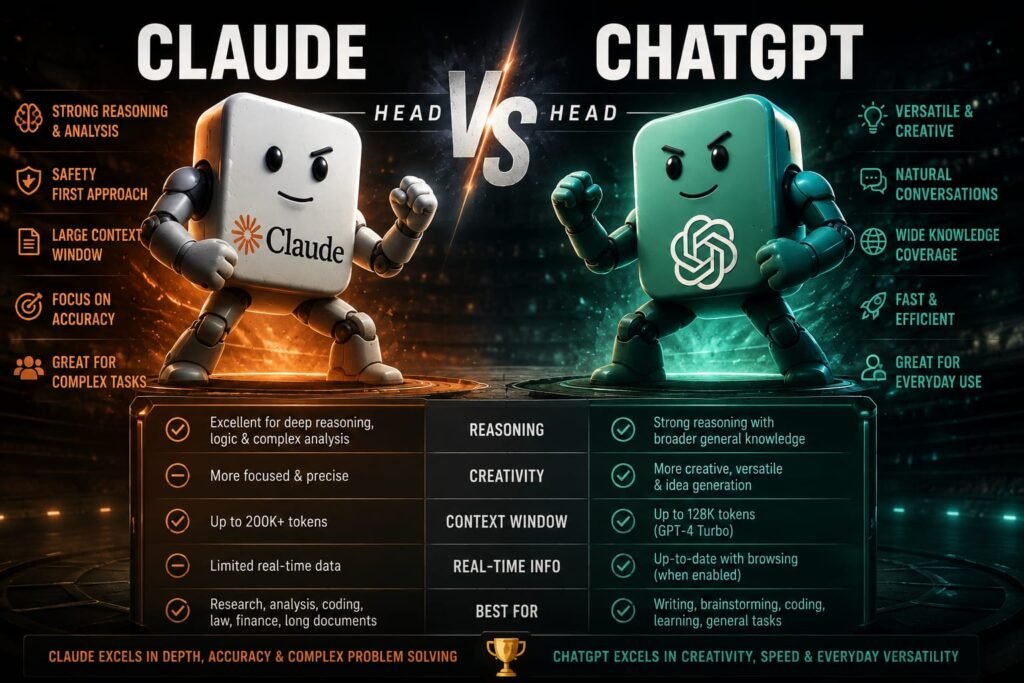
The most common comparison in 2026 is Claude versus ChatGPT. Both cost $20 per month at the entry level. Both handle coding, writing, and analysis. But they serve fundamentally different temperaments.
| Dimension | Claude | ChatGPT (GPT-5.5/5.6) |
|---|---|---|
| Coding style | Infers intent, fills gaps, ships production-ready code | Follows spec literally, fastest fix first |
| SWE-bench Verified | 88.6% (Opus 4.8) | 88.7% (GPT-5.5) |
| SWE-bench Pro | 69.2% (Opus 4.8) | 58.6% (GPT-5.5) |
| Writing tone | Natural, direct, fewer clichés | Faster, more structured, occasional sycophancy |
| Images | No | Yes, native on all tiers |
| Voice | Dictation only | Full spoken conversation |
| Context window | 1M tokens, no surcharge | ~1M tokens, 2x surcharge above 272K |
| Usage limits | Tight 5-hour windows | Looser message counts |
| Entry price | $20/mo (Pro) | $20/mo (Plus), $8/mo (Go) |
The verdict: Use Claude when the task is ambiguous, the context is long, or the output needs to feel human. Use ChatGPT when you have a clear plan, need images or voice, or want the fastest all-around assistant.
Claude vs Gemini: Research and Ecosystem
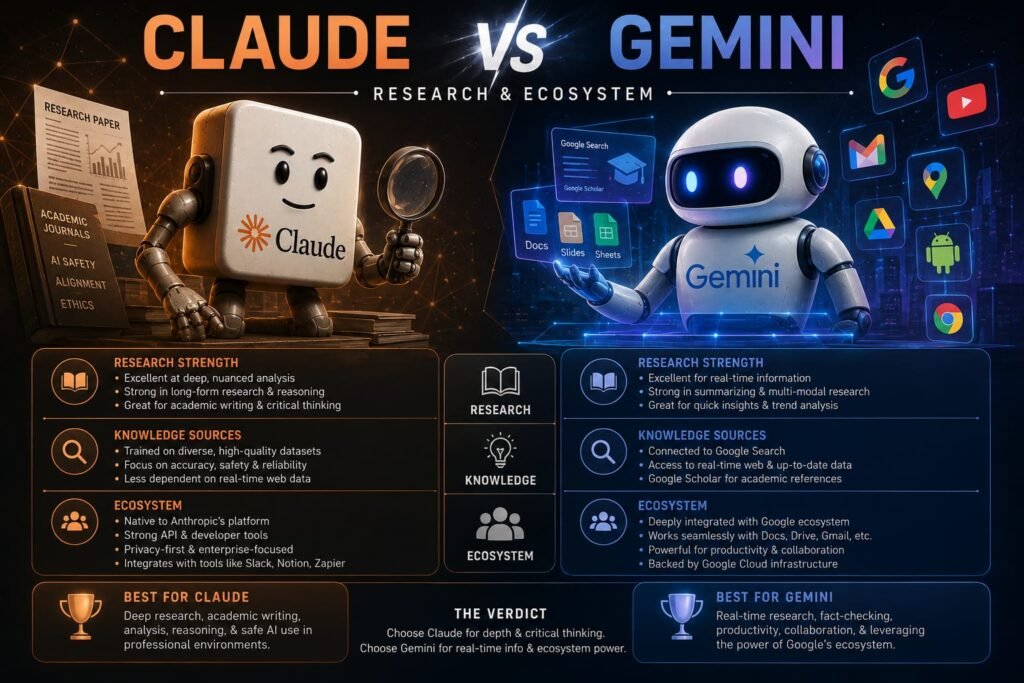
Google’s Gemini 3.1 Pro excels at research-heavy workflows and integrates natively with Google Workspace, Looker Studio, and Google Ads. Its FACTS Grounding score of 93.2% edges Claude’s 92% on marketing claim fact-checking.
For teams embedded in the Google ecosystem, Gemini’s native connectors reduce integration setup time by roughly 80% compared to Claude’s API-plus-script approach. However, Gemini’s writing style is consistently wordier and lower in signal-to-noise ratio than Claude’s.
Is Claude better than Gemini? Claude wins on writing quality, coding depth, and natural tone. Gemini wins on research volume, factual grounding, and native integration with Google Workspace. Pick Claude for finished prose; pick Gemini for data synthesis within Google’s ecosystem.
Claude vs DeepSeek: The Price Gap
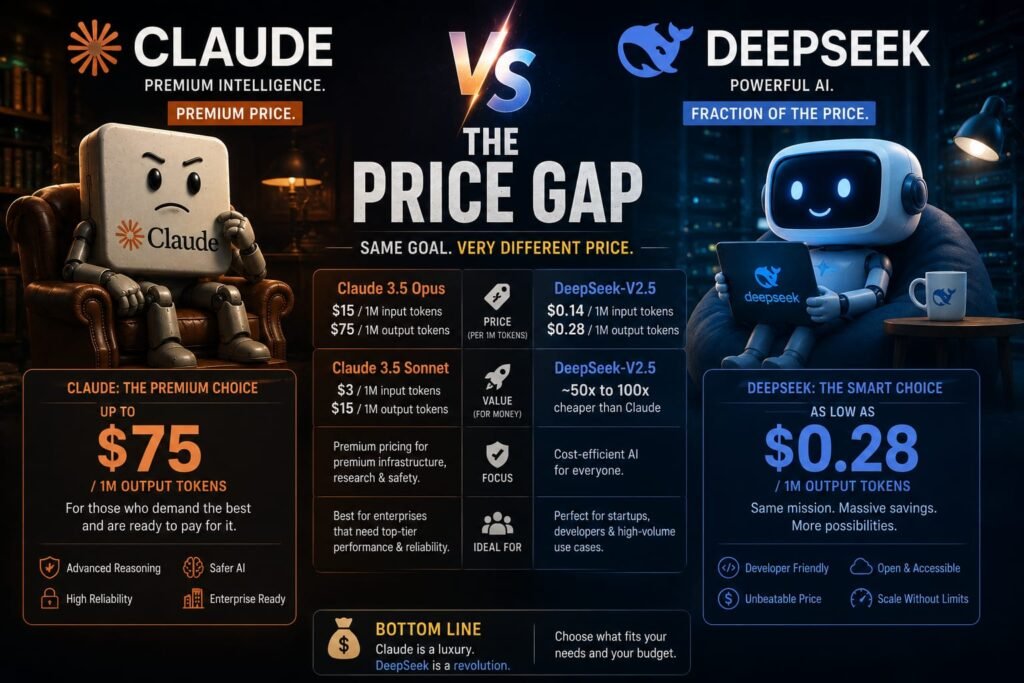
DeepSeek V4 offers frontier-level coding performance at roughly one-sixth the API cost of Claude. At approximately $0.35–$0.40 per million tokens versus Claude Opus’s $5/$25, DeepSeek is the undisputed value leader.
However, DeepSeek requires heavier fact-checking and editing. One independent test found DeepSeek fabricated statistics in consecutive runs—claiming “67% of marketing teams,” then “73% of CMOs,” then “81% of enterprise teams” for the same prompt. Claude produced consistent, verifiable outputs.
For cost-sensitive, high-volume pipelines where human verification is built in, DeepSeek is compelling. For work that ships without a second pair of eyes, Claude’s reliability justifies the premium.
Claude Pricing in 2026: What You Actually Pay
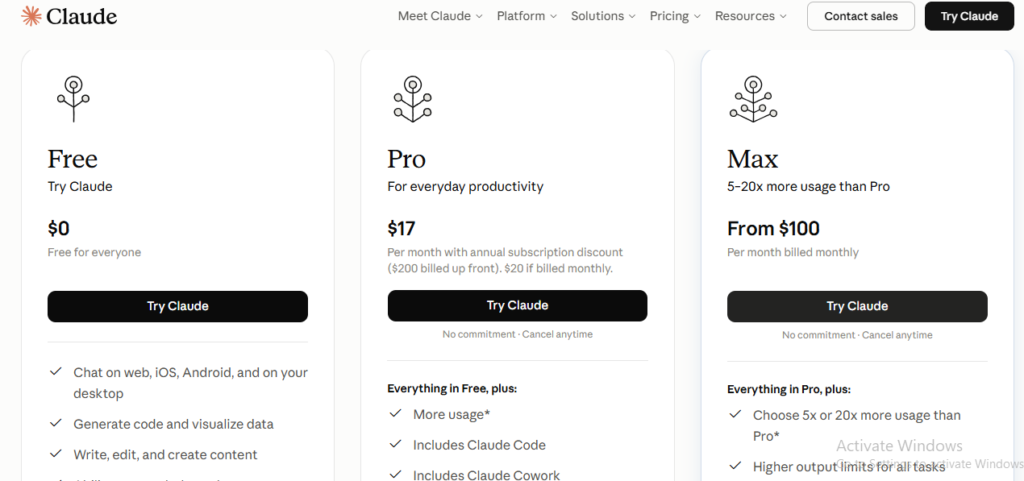
Subscription Plans
| Plan | Price | Best For |
|---|---|---|
| Free | $0 | Evaluation, light reading and writing |
| Pro | $20/mo ($17/mo annual) | Individual professionals, daily work |
| Max 5x | $100/mo | Heavy individual use |
| Max 20x | $200/mo | Power users living in Claude Code |
| Team Standard | $25/seat/mo ($20 annual) | Small teams |
| Team Premium | $125/seat/mo ($100 annual) | Teams needing 5x Standard usage |
| Enterprise | Custom | Large orgs, compliance, 500K context |
API Pricing
| Model | Input | Output | Cache Hit |
|---|---|---|---|
| Fable 5 | $10 | $50 | $1.00 |
| Opus 5 | $5 | $25 | $0.50 |
| Sonnet 5 | $3 | $15 | $0.30 |
| Haiku 4.5 | $1 | $5 | $0.10 |
Critical cost insight: Subscriptions are flat-rate arbitrage for heavy interactive users. A developer running 200M input tokens and 10M output tokens through Opus would pay $426 on the API but only $200 on Max 20x. However, if an ANTHROPIC_API_KEY environment variable is set in your shell, Claude Code bills at API rates and ignores your subscription entirely—a trap more than one team has discovered on the invoice.
Real User Feedback: What People Actually Say
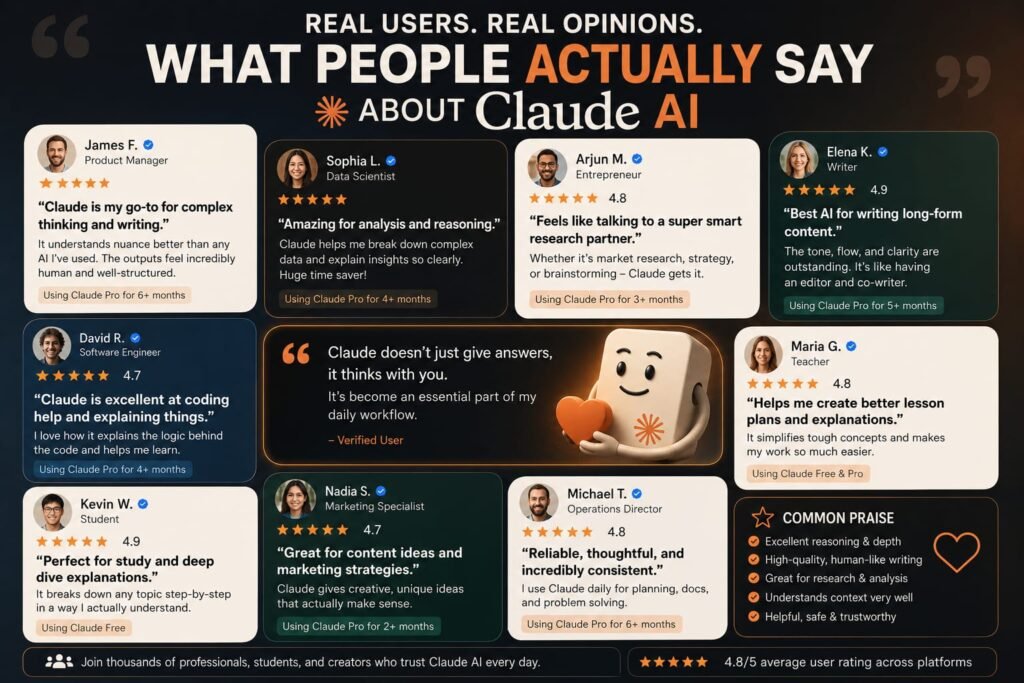
Verified reviews on G2 and Capterra, plus community threads, reveal a consistent pattern:
What users love about Claude:
- Accuracy and structure of answers
- Natural writing that needs minimal editing
- Claude Code for shipping software without an engineering background
- Holding context across long documents
What users hate about Claude:
- Usage limits are the loudest complaint by far
- The $20-to-$100 gap with no mid-tier
- No image generation at any price
- Slower responses on heavy reasoning tasks
- Tighter session limits during peak hours
The Reddit consensus: Many heavy users simply pay $40/month for both Claude and ChatGPT, routing by task. As one user put it: “Claude is better, but the limits when paying $20/month is starting to irritate me.”
Who Should Use Claude
Claude is the best choice if:
- You write long-form content, code, or analysis that needs to read finished on the first pass
- Your tasks are ambiguous and require the model to infer intent
- You work with long documents, codebases, or contracts that need 1M-token context
- You value natural tone and minimal AI clichés over speed
- You are a developer who wants production-ready code with error handling built in
Claude is not the best choice if:
- You need image generation, voice conversations, or video in your workflow
- You generate high volume on a tight budget (DeepSeek wins on price)
- You bounce between many small tasks and need the fastest responses
- You are frustrated by usage limits and want looser caps at $20/month
- Your team is embedded in Google Workspace and values native integrations
Frequently Asked Questions
Is Claude the best AI in 2026?
Claude is the best AI for specific tasks—ambiguous coding, long-form writing, and deep reasoning—but not universally. GPT-5.6 Sol leads on well-specified coding tasks and agentic automation. Gemini leads on research volume and Google ecosystem integration. DeepSeek leads on price. The “best” AI depends on your workflow.
Is Claude better than ChatGPT?
For writing quality, coding depth on hard problems, and natural tone, yes. For speed, image generation, voice mode, and looser usage limits, no. The models are effectively tied on standard coding benchmarks (88.6% vs 88.7% SWE-bench Verified) but diverge on harder variants and real-world temperament.
Which Claude model is best?
Claude Fable 5 is the highest-scoring model for the hardest reasoning and agentic tasks. Claude Opus 5 is the best everyday default for coding and analysis. Claude Sonnet 5 is the cost-efficient choice for high-volume daily work. Claude Haiku 4.5 is the speed and budget leader for lightweight tasks.
How much does Claude cost?
Claude Pro is $20 per month ($17 annual). Max tiers are $100 and $200 per month. API pricing ranges from $1/$5 per million tokens (Haiku) to $10/$50 (Fable). Team plans start at $25 per seat per month.
Does Claude have usage limits?
Yes. All subscription tiers operate on rolling 5-hour session limits. In March 2026, Anthropic tightened peak-hour limits. Heavy users can burn through weekly allowances in one or two days. There is no unlimited tier.
Can Claude generate images?
No. Claude cannot generate images, hold voice conversations, or produce video at any price point. ChatGPT handles all three natively.
Is Claude free?
Yes, Claude offers a free tier with access to Sonnet 5, memory, web search, and file uploads. It is more generous than ChatGPT Free for reading and writing but has no image generation.
Is Claude safe for commercial use?
Yes. Paid plans include commercial usage rights. Enterprise plans add SCIM, audit logs, custom data retention, and a compliance API. Anthropic commits to a 9-month minimum support window for deprecated models.
What is Claude Code?
Claude Code is Anthropic’s terminal-native coding agent included in every paid plan. It autonomously explores codebases, edits files, runs tests, and iterates until tasks complete. It shares the same usage pool as chat and Cowork.
Why do people switch from Claude to ChatGPT?
The most common reason is usage limits. The $20 Pro plan caps are tight, and the jump to $100 Max is steep. Users also leave because Claude lacks images, voice, and video—features ChatGPT includes even on its free tier.
My Final Conclusion: Is Claude the Best AI for You in 2026?
So is claude the best ai? The honest answer is that it is the best at specific things that matter deeply to specific people. If your work rewards depth—writing that reads human, code that ships production-ready, analysis that holds together across a million tokens—Claude is genuinely unmatched. The benchmark numbers back it up. The user loyalty backs it up. The tone and quality are real.
But if you need an all-in-one assistant that generates images, holds voice conversations, and never tells you to come back in five hours, Claude is not the best AI for you. It is a specialist in a world of generalists. And that specialization comes with trade-offs: higher prices at the top end, tighter limits at the entry level, and a feature gap that competitors fill effortlessly.
My recommendation: Start with Claude’s free tier. Use it for your actual work—not demo prompts. Write a blog post. Debug a script. Upload a long contract and ask for analysis. If the output quality saves you more editing time than the limits cost you in frustration, upgrade to Pro. If you hit the Pro ceiling within a week, you have your answer—and your justification for Max. If you find yourself missing images, voice, or speed, keep ChatGPT alongside it. The best AI setup in 2026 is rarely one tool. It is the right tool for the right task.
Ready to test Claude? Sign up at claude.ai with no credit card required. Run a real task from your current workflow. Time how long the response takes, count how many follow-up prompts you need, and note whether the output needs editing before you would share it. That single test will tell you more about whether Claude is the best AI for you than any benchmark ever could.
Want to explore how Claude compares with other leading AI tools? If you’re evaluating the AI landscape beyond Claude, check out our detailed guides on Grok 4.5, Kimi AI, and ChatGPT to see how different models compare in performance, features, and real-world use cases. You can also read our comparison of Claude Pro vs ChatGPT Plus to understand which premium AI subscription offers better value. For readers interested in multimodal AI, our guide to Gemini Image-to-Video explores Google’s latest creative capabilities, while our Qwen 3.8 features and pricing article covers another powerful alternative. Finally, don’t miss our Kimi AI vs ChatGPT comparison for a closer look at two increasingly popular AI assistants.
Related Reads:
What Is Lovable AI? The Complete Guide to the AI App Builder Everyone’s Talking About
Is Lovable AI Free? Here’s What You Actually Get
Claude Pro vs ChatGPT Plus: The Real Difference Between These $20 AI Plans
How to Fix AI Image Generator Deformities in Fingers, Toes, and Other Anomalies
What Is Meta AI Muse Spark? The Complete 2026 Guide to Meta’s Flagship AI Model
Kimi K3 Explained: Inside Moonshot AI’s Record-Breaking Open Mode
Best AI App Builder in 2026: 10 Top Tools to Build an App Without Coding
Seedance 2: Inside ByteDance’s Most Realistic AI Video Model Yet (2026)
Is Kling 3.0 Unlimited? The Honest Truth About Free Credits, Paid Plans, and Hidden Costs in 2026